Your team has probably had this argument already. One side says Page Likes are a vanity metric. The other side says they still matter because followers lower friction for future launches, community posts, and retargeting paths inside Meta's ecosystem.
Both sides are partly right. Bad Page Like campaigns buy cheap, low-intent followers and create reporting noise. Good page like ads on Facebook build an audience asset that gives paid social, brand, and content teams a larger pool of people who already recognize the business.
That difference usually comes down to operations, not just ad setup. Enterprise teams don't struggle because they can't click “create campaign.” They struggle because multiple people touch targeting, creative, approvals, budgets, reporting, and governance at the same time. If the workflow is loose, the campaign gets messy fast.
Table of Contents
- Start with controlled budgets, not broad spend
- Measure success beyond the platform headline number
- Build reporting that survives scale
Why Page Like Ads Still Matter in 2026
A regional brand team launches a product update, posts it on Facebook, and realizes the Page audience is too thin to give the content any real lift. Paid social can still force reach, but that gets expensive when every announcement starts from zero. Page Like campaigns solve a different problem. They help teams build a reusable audience the brand can reach again through organic posts, retargeting, and follow-on paid campaigns.

The mistake is treating follower growth as cheap volume buying. Enterprise teams get value from Page Like ads when they use them to recruit the right audience, not the biggest audience. That distinction matters. A weak follower base inflates reporting and gives community managers a dead asset. A qualified follower base gives the team a warmer pool for launches, social proof, and retargeting.
Meta has long treated this as a defined outcome with clear delivery metrics, including Page likes and cost per Page like. That framing matters for governance. It gives media buyers, account managers, and leadership a shared way to judge whether the campaign is acquiring an audience efficiently, rather than lumping it into broad awareness activity.
The value isn't the like by itself
A Page Like has practical function because it reduces friction between first touch and later conversion activity. Someone who chooses to follow a Page has signaled at least baseline relevance. That does not make them sales-ready, and strong teams should be honest about that trade-off. It does make future impressions easier to justify, especially for brands that publish consistently and have a clear post-click path into leads, trials, or purchases.
Historical benchmarks help explain why this objective became common in the first place. KlientBoost cited average cost per like figures from earlier Page Like campaign benchmarking, including lower costs in mobile feed placements, in its review of campaign economics. Those numbers are not a current pricing benchmark, but they are a useful reminder that follower acquisition has always been a lower-commitment action than a lead form or purchase.
The operational question is simple. What will the team do with the follower after acquisition?
Practical rule: If your team can't explain how new followers will be used after acquisition, don't run a Page Like campaign yet.
That is where many programs break. Paid media buys the audience, social teams publish without a retention plan, reporting stays focused on low cost per like, and leadership assumes audience growth equals demand generation. It does not. Teams need a shared workflow for how followers move into the broader paid and organic system. For teams trying to connect audience growth with downstream demand generation, resources like Cometly's Facebook lead guide are useful because they help frame where follower growth fits relative to lead capture and conversion-focused campaigns.
Teams need a shared definition of success
Page Like ads still matter for organizations that treat the Page as an owned audience asset and manage it with the same discipline they apply to lead generation. The goal is not to collect likes for a monthly report. The goal is to build a reachable, relevant audience the team can use across campaigns and regions.
That requires coordination across functions:
- Media buyers need clear audience rules and cost controls.
- Creative teams need a precise picture of who the Page should attract.
- Marketing leads need reporting that separates low-cost followers from useful followers.
- Operations teams need naming standards, permissions, QA, and workflow control across markets.
- Platform owners using Koast need campaign execution and approvals centralized so scaling does not create versioning and governance problems.
Without that operating model, Page Likes become a vanity metric. With it, they become an audience-building program that supports the rest of the account.
Blueprint for a Scalable Campaign Structure
A Page Like program usually breaks before spend becomes the problem. One region uses one naming system, another duplicates audiences, creative versions get mixed together, and weekly reporting turns into reconciliation work instead of decision-making.
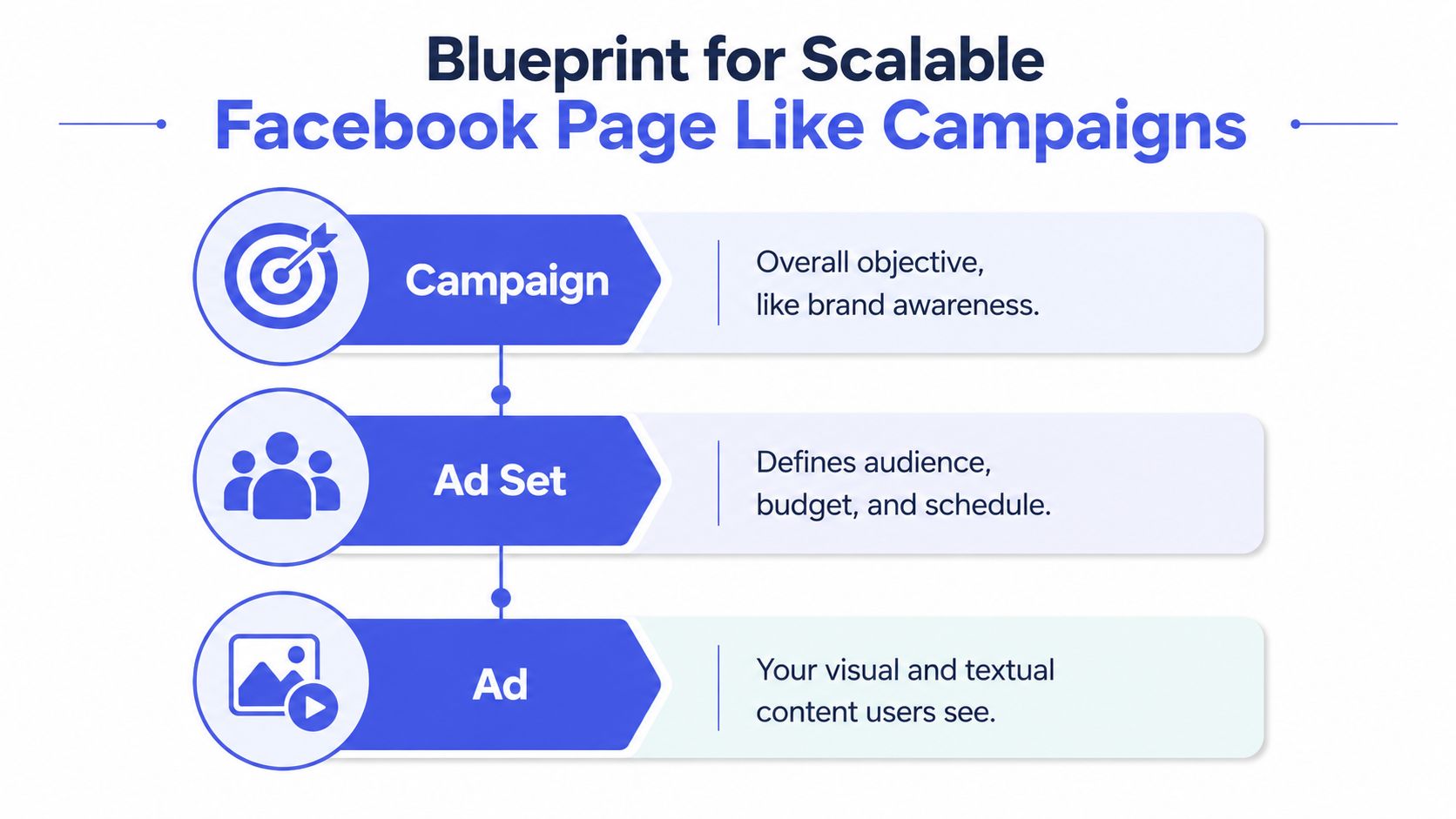
Scalable structure fixes that by making ownership clear at each level of the build. Campaigns hold the objective and top-line budget logic. Ad sets separate audiences, placements, geography, and pacing choices. Ads isolate the message and format variables the creative team is testing. In enterprise accounts, that separation is what keeps reporting usable and approvals fast.
Treat structure like reporting infrastructure
Campaign structure is an operating system, not just a build preference. If a buyer, analyst, creative lead, and regional marketer cannot read a campaign name and understand what changed, the account will slow down as volume grows.
A naming format like [Date][CampaignObjective][Region]_[Audience] keeps reviews clean because each team sees the same source of truth. It also reduces avoidable errors during handoff, especially when multiple people are building inside the same account or routing work through Koast for approvals and version control.
Use a simple role split:
| Level | Primary role | What should vary |
|---|---|---|
| Campaign | Objective control | Only the high-level campaign purpose |
| Ad Set | Audience and spend control | Audience segment, budget, schedule |
| Ad | Message testing | Hook, image or video, primary text |
If teams skip this discipline, the cost shows up quickly:
- Reporting breaks down: Weekly reviews become cleanup work.
- Tests lose clarity: Audience and creative changes overlap, so nobody knows what caused the result.
- Approvals stall: Ownership is unclear, and teams waste time retracing decisions.
A structured account lets buyers act fast, analysts trust the comparison set, and leadership review performance without asking for a custom explanation every week.
Teams that also manage publishing and access across multiple Pages should cut Facebook Page token headaches before campaign volume increases. The operational drag from expired tokens, broken permissions, and patchwork workflows shows up in campaign execution sooner than many teams expect.
Later in the build, this walkthrough is worth using as a visual reference:
Build segmented ad sets from day one
The cleanest Page Like accounts separate segments early. Do not put every audience into one ad set just because the objective is simple. That makes budget allocation harder, hides performance differences, and creates QA problems once teams start localizing creative or adjusting spend by market.
A practical setup usually groups ad sets into three buckets:
- Relationship-based audiences: customer files, email subscribers, site visitors
- Modeled audiences: lookalikes built from high-quality first-party sources
- Exploration audiences: broader interests and behavioral pools used after tighter segments are covered
This gives the team real decision points. Buyers can shift spend without disturbing the whole campaign. Creative teams can map specific hooks to each segment. Analysts can compare acquisition cost and follower quality by audience group instead of trying to reconstruct intent after launch.
The trade-off is complexity. More ad sets mean more QA, more naming discipline, and more coordination between media, creative, and ops. For large teams, that trade is usually worth it because it preserves learning. For smaller teams, the answer is not to collapse everything into one bucket. It is to limit the number of segments to what the team can govern.
Teams using automation to manage those decisions at scale should also review how AI changes audience targeting workflows. The value is not automation for its own sake. The value is faster audience iteration with approval control, cleaner execution across markets, and fewer manual errors as the program grows.
This structure makes scaling possible without turning the account into a shared spreadsheet problem.
Targeting Strategies for High-Quality Followers
A team can hit its cost-per-like target and still come away with the wrong audience. That usually shows up later, when follower growth looks healthy but post engagement, remarketing performance, and downstream conversion quality stay weak.
High-quality Page Like targeting starts with audience proximity to the brand. For this reason, experienced practitioners expand from known relationship signals into modeled and discovery segments, instead of starting broad and hoping Meta sorts it out. In practice, that means the first audiences should already have a believable reason to follow the Page, whether that comes from customer status, site activity, or strong first-party seed data.
Start with the closest audiences first
A follower from an existing relationship usually carries more business value than a follower from a cold interest pool. The job is not to avoid broad targeting forever. The job is to earn the right to expand by proving quality in the tighter layers first.
Use a priority stack like this:
Customer and CRM-derived audiences
Upload lists tied to actual value, such as customers, qualified leads, subscribers, or high-LTV segments. If the source data is outdated or loosely tagged, clean it before it enters the account.Website visitor audiences
Segment by meaningful behavior, not just all traffic. Product viewers, pricing page visitors, and repeat visitors often outperform generic site pools because the relationship is already established.Lookalikes from strong seed audiences
Build these from sources your team trusts. If the seed is low-intent, the expansion usually inherits that weakness.Interest and behavior discovery
Treat this as a testing layer. It helps find scale, but it rarely deserves the same trust level on day one as first-party or modeled audiences.
Enterprise execution usually breaks down as one buyer names an audience one way, another buyer rebuilds the same segment with different exclusions, and analysts spend the next reporting cycle trying to compare unlike-for-like ad sets. Central audience definitions solve that. Store approved audience logic in one system, document the intended use case, and make new tests accountable to that naming and approval standard.
Teams that want faster iteration without losing approval control should review Koast's perspective on how AI changes audience targeting methods. The advantage is operational. Teams can test more audience variations, keep definitions consistent across markets, and reduce manual setup errors.
Expand only when follower quality stays intact
Expansion should follow signal quality, not impatience.
If close-intent audiences are producing followers who engage with posts, respond to retargeting, and match the brand's customer profile, then broader layers make sense. If those signals are weak, scaling the same logic only buys more low-value followers faster.
The main trade-off is straightforward:
- Too broad, and follower quality drops.
- Too narrow, and delivery gets expensive or unstable.
- Too fragmented, and the team creates overlap, duplicate learning, and unnecessary QA load.
The fix is governance, not just targeting skill. Require each ad set owner to define three points before launch: why this audience should follow the Page, how it differs from adjacent audiences, and which message it will receive. That standard gives media buyers, creative leads, and analysts a shared frame for reviewing performance. It also makes scaling easier because good audience decisions become repeatable team practice instead of isolated account knowledge.
Creative That Acts as Your Best Targeting Tool
A lot of teams still think targeting lives mostly in audience filters. That's outdated. In modern Meta delivery, creative helps determine who sees the ad.
Recent practitioner guidance makes that point directly. Meta can use ad copy and visuals as part of audience targeting, which means audience selection is no longer the only meaningful lever. The better question is which creative angles help the system identify likely followers, as discussed in this practitioner note on creative as a targeting signal.
Creative now helps the system find the audience
That changes how page like ads on Facebook should be briefed.
Instead of asking for “a Page Like ad,” ask for creative designed to attract a specific type of follower. A B2B SaaS brand might test a product-education angle, a category-opinion angle, and a customer-proof angle. A retail brand might test community identity, product drops, and lifestyle association. Each angle sends a different signal.
Here's what tends to work better than generic branding:
- Clear identity cues: Show who the brand is for. Don't make people guess.
- Specific value language: Tell users what they'll get from following the Page, such as updates, offers, product education, or community content.
- Visual relevance: Match the look and tone to the audience segment instead of recycling one master brand asset everywhere.
What usually underperforms is broad, polite creative that could apply to anyone. If the message tries to attract everybody, the system gets a weaker signal.
Build a testing matrix the whole team can use
Creative-led targeting only works if the team can test methodically. Don't let every buyer invent ad variants in isolation. Build a shared matrix with a few controlled dimensions:
| Variable | Example question |
|---|---|
| Hook | Are we leading with identity, value, or proof? |
| Format | Does static or short-form video better attract likely followers? |
| Offer to follow | Why should someone follow this Page now? |
| Audience fit | Which segment is this message written for? |
Centralized asset management is important. Approved visuals, copy variants, and past winning concepts are stored in one library with clear tags. That gives buyers speed without losing governance, and it keeps creative teams from remaking assets that already exist.
For teams building that process with automation support, this guide to AI-powered ad creative workflows gives a useful model for turning scattered asset testing into a repeatable system.
Creative review rule: If your team can swap the Page name with another brand and the ad still makes sense, the creative is too generic.
Setting Budgets and Measuring True Success
A common failure pattern looks like this. The team gets cheap Page likes in week one, celebrates the cost number, then realizes a month later that the new followers never engage, never click through, and never help future campaigns. Budgeting for Page Like ads has to protect against that outcome from the start.
The goal is a baseline your team can trust. Meta's native metrics for this objective still start with Page likes and cost per Page like, but those numbers only matter if they are tied to follower quality and reported the same way across buyers, managers, and stakeholders.
Start with controlled budgets, not broad spend
Early-stage Page Like campaigns work better with deliberate budget constraints. Small ad set budgets make it easier to compare audiences, spot weak segments fast, and avoid hiding poor performance inside pooled delivery.
A practical setup usually includes:
- Use ad set budgets first: ABO gives cleaner readouts during testing because each audience has its own spend and its own result profile.
- Define a review window in advance: Give the team a fixed checkpoint for evaluation so nobody reacts to half a day of noisy delivery.
- Increase spend only on stable winners: Raise budgets on segments that hold an acceptable cost per like and show signs of being useful followers, not just cheap ones.
I usually keep CBO out of the first testing cycle for this reason. It is efficient once the account already has clear winners, but it can shift budget too quickly toward whichever audience gets the cheapest early likes, even if that audience is weak long term.
For enterprise teams, that choice is not just a buying preference. It affects reporting discipline, approval speed, and how confidently different markets can reuse the same playbook.
Measure success beyond the platform headline number
Reach and impressions help explain delivery. They do not define success here.
Use a shared KPI set that answers two questions: are we acquiring followers efficiently, and are those followers adding business value later?
Track:
- Page likes: The direct acquisition output for the campaign.
- Cost per Page like: The primary efficiency metric for this objective.
- Incremental follower growth: The lift created by paid activity compared with normal organic growth patterns.
- Early downstream quality signals: Post engagement, return visits, or assisted traffic from newly acquired followers, depending on how your team measures Page value.
- Delivery diagnostics: Frequency, CPM, and CTR for troubleshooting, not as the headline result.
That last distinction matters. Teams waste time when diagnostic metrics get treated as success metrics.
Build reporting that survives scale
A buyer looking at Ads Manager, a social lead building a weekly report, and a director preparing for a budget review should all be working from the same definitions. If each team pulls numbers manually, disagreements show up fast. One report counts total likes. Another counts net new growth. A third excludes low-spend ad sets. Nobody is wrong, but nobody is aligned either.
Set the rules before launch. Define the source of truth, the attribution window your team will use internally, the threshold for a “scalable” cost per like, and who signs off before budgets increase.
If the campaign spans multiple brands or regions, centralizing that workflow matters even more. A repeatable process for bulk builds and coordinated reporting keeps budget tests consistent across accounts. Teams running that model can reduce setup overhead with a bulk Facebook ad launch workflow instead of rebuilding the same campaign logic by hand every time.
Scale Page Like campaigns after the team has proof of follower quality, stable efficiency, and shared reporting standards. Smooth spend pacing is not enough.
Automating and Scaling Your Page Like Campaigns with Koast
A regional team approves creative at 10 a.m. Brand managers in three markets sign off by noon. By end of day, the media team still has not launched because naming conventions differ, asset versions are scattered, and each account needs the same campaign rebuilt by hand. That is the point where Page Like campaigns stop being a media problem and start becoming an operating problem.
Manual execution breaks first
On larger teams, strategy usually survives scale better than execution does.
Audience logic may be solid. Creative may be approved. Reporting definitions may already be set. Then the handoff chain slows everything down. One person builds audiences, another checks assets, a buyer duplicates ad sets across accounts, and someone else tries to track approvals in chat. The result is familiar: delayed launches, inconsistent setup, and weak visibility into who changed what.
Centralized execution solves that operational drag. The value is not convenience. The value is control the team can maintain across brands, regions, and business units.
A strong operating model should include:
- Templates for repeatable builds: Approved campaign structures stay consistent instead of getting rebuilt from scratch.
- Shared creative and audience libraries: Teams can reuse what already passed review and performed well.
- Role-based permissions: Media, creative, and admin stakeholders can work in one system without accidental edits.
- Change logs: Teams can trace edits, approvals, and launch activity without chasing screenshots.
What automation changes at scale
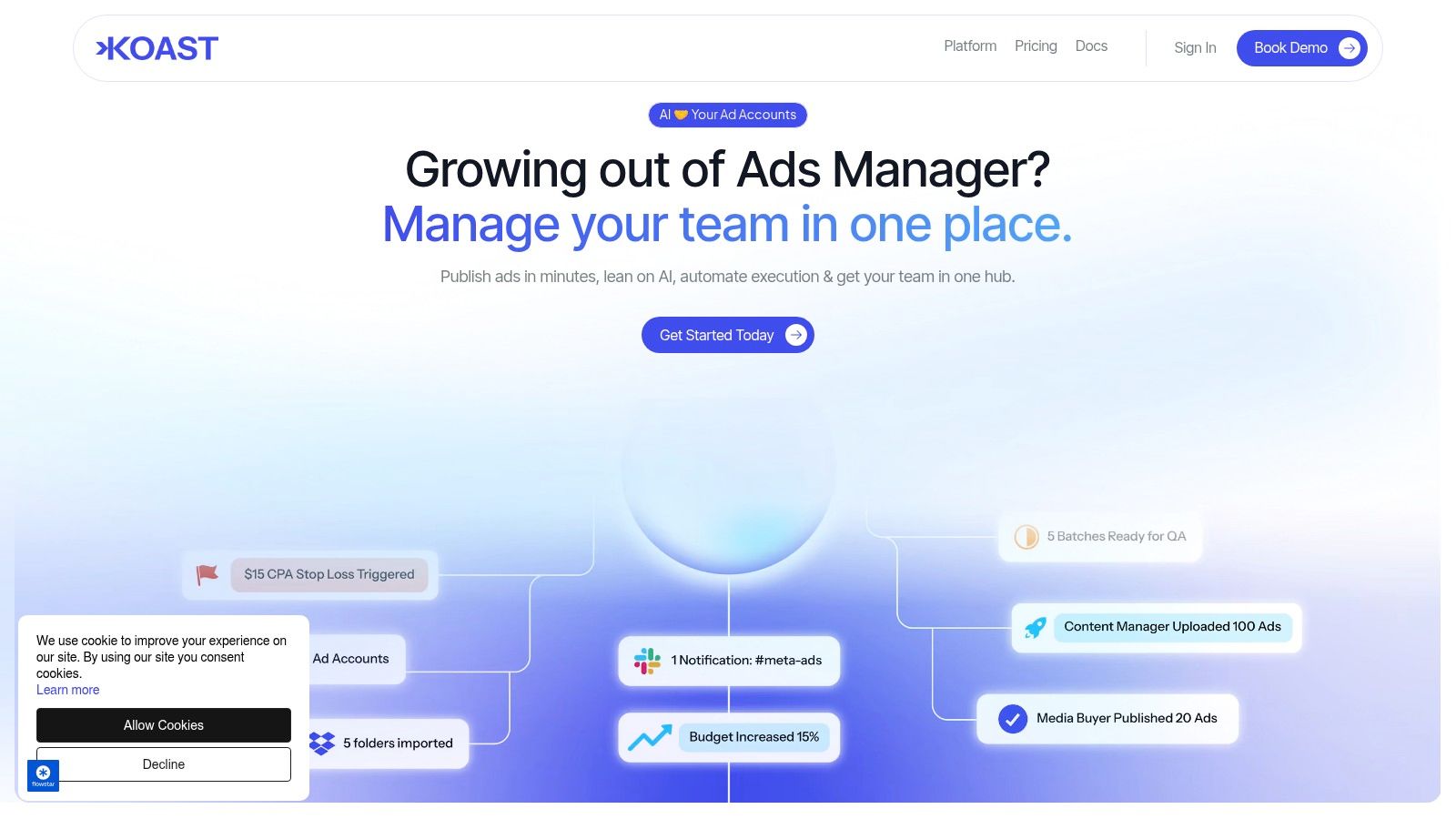
Koast handles the repetitive parts of campaign execution so the team can focus on the decisions that affect follower quality and cost efficiency. Its bulk Facebook ad launch system for multi-account campaign setup supports templated builds, centralized assets, KPI tracking, and rule-based optimization across accounts.
That matters in Page Like campaigns because scale rarely comes from one large bet. It comes from many controlled tests running at once. Different audience clusters. Different creative hooks. Different approval paths. Different budget thresholds by market. If those moving parts are managed manually, errors multiply quickly and teams spend more time checking setup than improving performance.
A mature process usually includes five pieces:
Build once, reuse often
Save a campaign structure with the right naming rules, segmentation logic, and QA checks so every launch starts from the same standard.Launch across accounts with consistency
Agency teams, multi-brand groups, and regional operators can deploy the same follower-growth model without manual duplication in each ad account.Apply rules for pacing and protection
Losing ad sets can be paused faster. Stable ad sets can scale within guardrails the team already approved.Keep collaboration inside the system
Shared dashboards and live status updates reduce approval bottlenecks and cut down on back-and-forth across Slack and email.Preserve governance while volume increases
Leadership gets oversight through permissions, logs, and standardized builds instead of relying on spot checks after launch.
This is also where enterprise teams separate automation from autopilot. Automation handles repetition. The team still owns judgment. Buyers decide which audiences deserve more budget. Social leads review whether new followers engage after the initial like. Directors decide whether the campaign should expand, pause, or hold.
For teams under pressure to connect audience growth to business value, SleekPost's ROI guide is a useful reference for framing social performance beyond top-line engagement.
Well-run Page Like campaigns scale because execution becomes disciplined, visible, and repeatable. Koast helps teams get there without adding more manual admin every time a new market, brand, or test goes live.
Building an Audience Asset Not a Vanity Metric
Page Likes become a vanity metric when teams buy them cheaply, report them loosely, and never use them again. They become an audience asset when the campaign is structured carefully, targeted around relevance, and measured against cost per like and incremental value.
That's why the strongest page like ads on Facebook are rarely the flashiest. They're the ones managed with discipline. Clean naming. Clear audience sequencing. Creative that signals who should follow. Budgets that start small. Reporting that everyone trusts.
For teams that need a broader framework for proving value beyond surface engagement, SleekPost's ROI guide is a useful companion because it helps connect social activity to business outcomes instead of stopping at top-line metrics.
If your team treats follower growth as part of a larger audience system, the work compounds. Not because the metric is magical, but because the operation behind it is sound.
If your team wants to run Page Like campaigns with cleaner workflows, stronger governance, and less manual duplication, Koast is built for that kind of Meta ad execution.