You're probably looking at two dashboards that should agree and don't. Meta Ads says one thing. Your CRM says another. Sales is pushing back on lead quality, finance wants a cleaner read on return, and the media team is still being asked to scale spend by tomorrow.
That's usually when people ask, what is pixel tracking. Not as a theory question, but as an operations question. They want to know why attribution breaks, why audience sizes look wrong, and why teams can't agree on which number should drive budget decisions.
Pixel tracking started as a simple measurement mechanism. For modern marketing teams, it's now part of core data infrastructure. If you manage multiple campaigns, multiple markets, or multiple stakeholders, the core issue isn't just whether a pixel fires. It's whether the event taxonomy is clean, the consent logic is correct, the server-side layer is working, and everyone from paid social to ops to engineering is optimizing from the same definition of success.
Table of Contents
- What actually fires when someone visits a page
- The four-step mental model
- Why enterprise teams need standard event naming
- Retargeting based on real behavior
- Attribution that maps ads to business outcomes
- Lookalikes start with clean source data
- Why the shift happened
- Browser-Side vs. Server-Side Tracking at a Glance
- What teams get wrong about the comparison
- Measurement loss changes how teams work
- Consent management needs ownership
- GDPR and ATT affect different parts of the funnel
- Email opens are still a weak signal
- Centralize deployment and governance
- Use a hybrid tracking model
- Build workflows around shared assets and approvals
The Data Gap Plaguing Your Ad Campaigns
A familiar situation goes like this. The paid social team reports strong sales from Meta. The CRM team pulls a pipeline report and sees more closed deals than the ad platform shows. Nobody is technically wrong, but nobody can reconcile the gap fast enough to make a confident budget call.
That gap is where pixel tracking enters the conversation. At its most practical level, pixel tracking exists to connect user actions on a site with campaign activity in an ad platform. Without it, media buyers optimize for clicks and landing page views. With it, they can optimize toward business outcomes.

Why this matters in real ad operations
The reason this isn't a niche technical issue is scale. By April 2025, Meta Pixel was deployed on over 1.97 million active domains, making it the most widely used tracking technology on the web and the foundational infrastructure for ad measurement from local retailers to Fortune 500 enterprises according to Technology Checker's Meta Pixel usage data.
When a technology is this embedded in digital advertising, implementation quality becomes a team performance issue. A broken event doesn't just create a bad report. It affects bidding, audience building, creative testing, and the trust between marketing and revenue teams.
For enterprise teams, the problem usually isn't whether they have a pixel installed. It's whether the setup is governed well enough to support shared decision-making across accounts, brands, and regions. That includes naming conventions, access controls, testing processes, and a workflow for validating what ad platforms report against backend outcomes.
A lot of teams improve performance once they stop treating attribution discrepancies as isolated platform bugs and start treating them as a data operations problem. That's the same mindset behind better advertisement through data analytics.
Practical rule: If sales, finance, and paid media can't explain the same conversion event in the same way, you don't have a media optimization problem first. You have a tracking governance problem.
Where new team members usually get stuck
New marketers often assume pixel tracking is just for reporting. It isn't. It shapes who gets retargeted, which campaigns learn fastest, and how aggressively platforms can optimize delivery.
That's why understanding pixel tracking early matters. Not because you need to become an engineer, but because every serious campaign decision sits downstream of the data it sends.
How Pixel Tracking Works The Core Concept
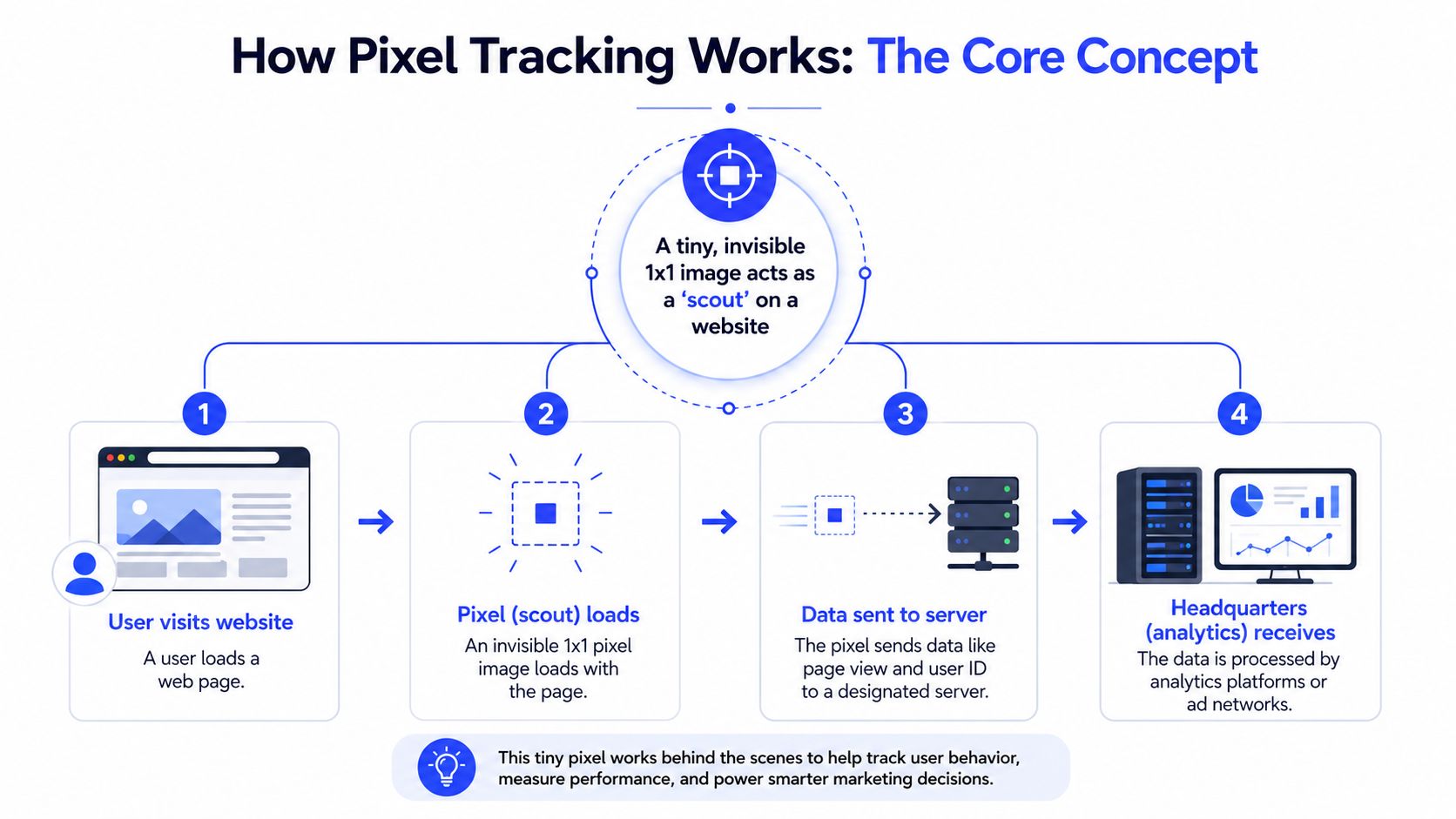
The simplest way to explain pixel tracking is this. A tiny, invisible 1×1 image acts like a scout on the page. When the page loads, or when a tracked action happens, that scout sends a signal back to a platform server.
That signal is the basis for attribution, audience creation, and optimization.
What actually fires when someone visits a page
A tracking setup usually includes JavaScript on the website. When the page loads, that script triggers a request. In classic pixel tracking, that request is tied to an invisible image. The request sends metadata to the ad or analytics platform.
That metadata can include timestamp, IP address, device type, operating system, screen resolution, browser details, and referrer URL, as described in Prescient AI's guide to tracking pixels.
If someone takes a meaningful action, the implementation can also send an event. Common website events include page views, product views, cart actions, and purchases. For lead generation teams, form submissions matter most. For ecommerce teams, checkout milestones and purchase completion usually drive the optimization model.
The four-step mental model
To illustrate:
- A user lands on the site. The browser loads the page and its scripts.
- The scout loads. The invisible pixel or JavaScript event sits inside the page experience.
- A request is sent. The browser passes metadata and event details to a tracking endpoint.
- The platform processes it. Meta, Google, or another system logs the event and uses it for reporting, attribution, audience rules, or optimization.
That's the core answer to what is pixel tracking. It's event transmission tied to user behavior.
Why enterprise teams need standard event naming
Clean implementation proves more critical than often anticipated. If one brand calls a form submission Lead, another calls it FormComplete, and a third fires both, reporting becomes messy fast.
A media buyer can't optimize confidently if the developer implemented the wrong trigger. A data analyst can't compare regional performance if event definitions change by market. A marketing ops lead can't govern ad accounts if every business unit creates its own naming logic.
Standardize events before you scale spend. Fixing taxonomy after campaigns are live is always slower, more political, and more expensive.
A good baseline for teams is to document three things together:
- What the event means: Define the business action in plain language.
- When it should fire: Tie it to an exact user action, not a vague page state.
- Who owns validation: Assign QA to marketing ops and implementation checks to engineering or the tag management owner.
Pixel tracking is simple in concept. The operational complexity comes from people, handoffs, and inconsistent definitions.
Pixel Data in Action Optimizing Meta Ad Campaigns
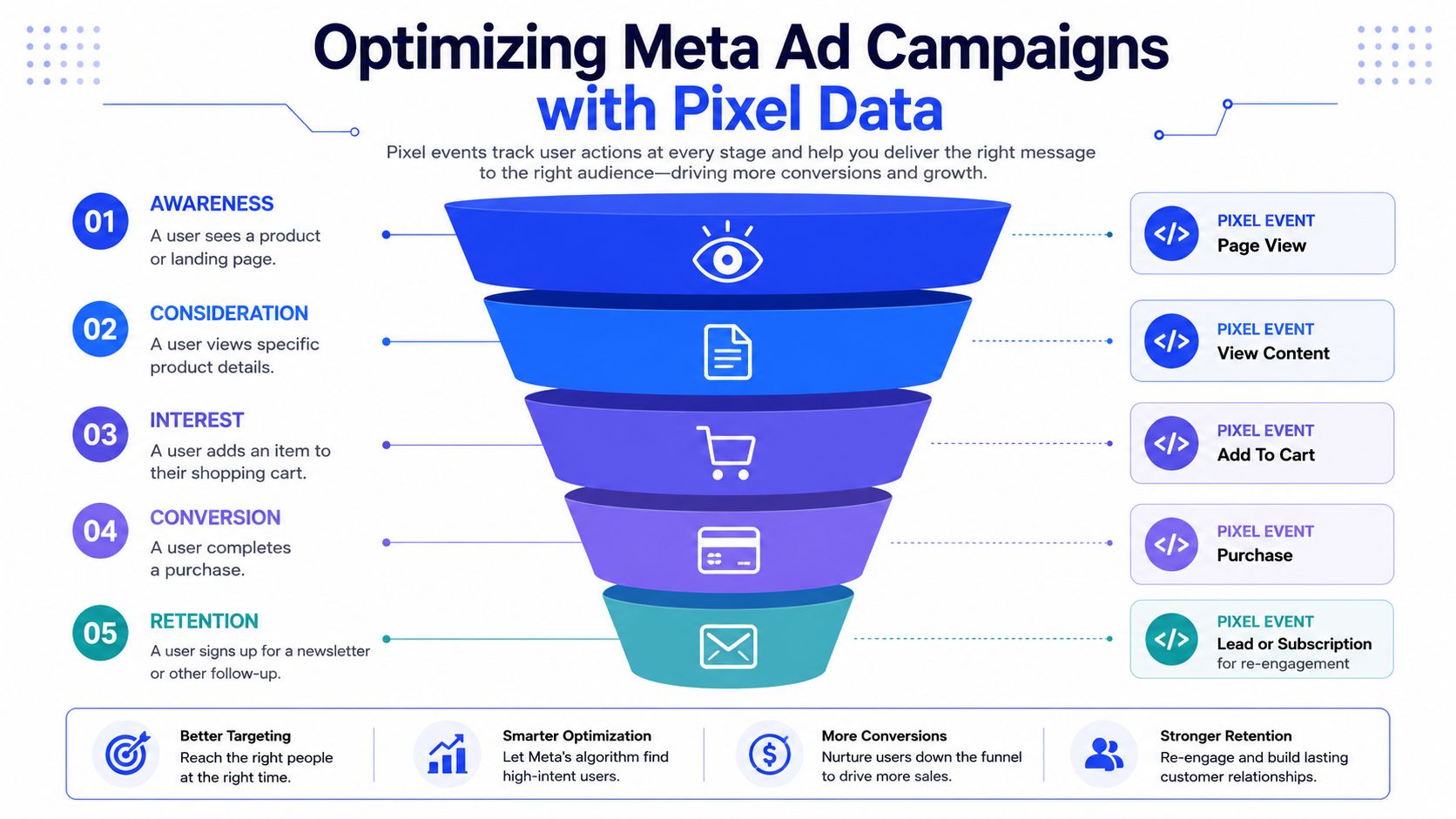
Pixel data becomes useful when it changes campaign behavior. On Meta, that usually happens in three places: retargeting, conversion attribution, and audience expansion.
If you've ever seen an ad account improve after cleaning up event quality, this is why. Better event data gives the platform a clearer view of which users matter and which actions deserve more delivery.
Retargeting based on real behavior
The most immediate use case is audience building. If a user views a product page, starts a checkout, or adds something to cart, the pixel can place that action into an audience rule. The paid social team can then retarget users who showed intent but didn't convert.
That sounds straightforward, but the collaboration piece matters. Creative strategists need to know which page interactions define intent. Media buyers need audience windows that match buying cycles. Developers need triggers that fire accurately across site templates.
If those teams aren't aligned, retargeting audiences become bloated, stale, or too thin to support stable delivery.
Attribution that maps ads to business outcomes
A second use case is conversion tracking. Pixel tracking fires a "Lead" conversion event when a user submits a form, sending metadata like device type and location to Meta. This allows marketing teams to map campaigns to real leads, feeding the attribution pipeline that reconstructs user journeys for collaborative optimization, as explained in Click Track Marketing's breakdown of lead identification.
That's the handoff point where ad performance stops being a vanity metric and starts becoming operational input. Once teams agree on the conversion event, they can compare creative, audience, and placement decisions against actual lead flow.
This is also where finance and growth teams usually start asking tougher questions about efficiency. If you need a simple framework for tying conversion value back to spend, Prometheus Agency's ROAS guide is a useful reference.
Lookalikes start with clean source data
The third use case is seeding higher-value audiences. When a platform has a dependable pool of users who completed a meaningful action, marketers can build lookalike audiences from that seed set.
The catch is quality. If your purchase event is noisy, duplicated, or mixed with low-intent actions, the expansion model gets worse. Teams then blame creative, offer, or platform volatility when the underlying issue is event integrity.
Here's the collaboration loop that tends to work:
- Media buyers define value: They identify which events should train campaign optimization.
- Developers implement the trigger logic: They make sure the correct action fires at the correct moment.
- Marketing ops validates output: They test in the browser, in the platform debugger, and against backend records.
- Analysts reconcile the downstream impact: They compare platform-reported outcomes with CRM or commerce system data.
The practical extension of that workflow is using systems that help teams review assets, launch structure, and tracking consistency together. One example is AI-powered Facebook Pixel optimization workflows, where the goal is to reduce the usual gap between campaign setup and measurement quality.
The strongest Meta accounts don't just have more creative tests. They have tighter agreement on which user actions count and how those actions are validated.
Browser Pixels vs Server-Side Tracking The New Standard
Browser-side pixels are the original setup many are familiar with. They live in the browser, depend on page execution, and send event data from the user's device to the ad platform.
Server-side tracking changes the route. Instead of relying only on the browser, backend systems send event data directly to the platform through an API such as Meta's Conversions API.
The easiest analogy is this. Browser pixels are postcards. Server-side tracking is a secure courier. A postcard can arrive quickly, but anyone can interrupt it, block it, or lose it. A courier has a more direct route and better control.
Why the shift happened
This change wasn't a stylistic preference. It was forced by platform and browser changes. Google's full removal of third-party cookies by mid-2024 forced 82% of marketers to rely more heavily on first-party pixel tracking and server-side solutions, which can increase data accuracy for cross-device campaign tracking by up to 45%, according to Mailchimp's pixel tracking resource.
For enterprise teams, that means browser-only tracking is no longer enough in many environments. It still has value. It captures on-site behavioral signals in real time. But it also gets disrupted by blockers, privacy settings, and browser limitations.
Browser-Side vs. Server-Side Tracking at a Glance
| Attribute | Browser-Side Pixel | Server-Side Tracking (Conversions API) |
|---|---|---|
| Where data is sent from | The user's browser | Your backend or server environment |
| Reliability | More exposed to browser restrictions and blocking | More resilient because it bypasses many client-side interruptions |
| Behavioral detail | Strong for page-level and session-level interaction signals | Strong for confirmed backend events like leads, purchases, or CRM milestones |
| Implementation owner | Often marketing ops or tag manager owner | Usually requires engineering, data, and marketing ops alignment |
| Governance challenge | Tag sprawl, duplicate fires, inconsistent triggers | Identity matching, payload structure, API monitoring |
| Best use | Real-time user behavior and audience building | Durable conversion capture and backend event reconciliation |
What teams get wrong about the comparison
The mistake is treating this as an either-or choice. In practice, strong teams use both. The browser captures intent signals close to the user interaction. The server confirms outcomes from systems of record.
That turns tracking into a shared infrastructure project. Marketing defines the events that matter. Engineering ensures backend systems can transmit them reliably. Data teams monitor event quality and deduplication. Marketing ops usually ends up coordinating the whole thing because they sit between media execution and system implementation.
If your attribution model affects budget allocation across Meta, Google, and LinkedIn, tracking architecture is no longer just a tagging task. It's revenue infrastructure.
For collaborative ad management, this matters even more in multi-account environments. A single naming mismatch or event-mapping error can distort optimization across several teams at once. The work isn't glamorous, but it's one of the clearest places where disciplined ops creates real media advantage.
Privacy and Compliance Navigating GDPR and ATT
A campaign launches on Monday. By Wednesday, paid social is underreporting purchases, legal is asking whether consent is being respected across every template, and sales is questioning lead quality because platform numbers do not match the CRM. That is what privacy regulation changed for enterprise teams. Pixel tracking is now part measurement problem, part governance problem.
GDPR raised the standard for consent collection and documentation. Apple's App Tracking Transparency reduced mobile app-level visibility. Browser limits, ad blockers, and consent banners add more points of failure. The result is not just less data. It is less agreement across teams about which data can be trusted.

Measurement loss changes how teams work
The issue is operational. Once consent rules and platform restrictions reduce observable events, every downstream workflow gets harder. Media buyers lose confidence in optimization signals. Analysts spend more time reconciling ad platform conversions against CRM and warehouse records. Legal and web teams get pulled into launch reviews because one misconfigured banner or trigger can affect both compliance and reporting.
In large organizations, this creates a coordination tax.
A privacy-safe setup needs clear event definitions, documented consent behavior, and routine QA after site updates. If one team updates templates, another edits the consent manager, and a third publishes new campaign tags, gaps appear fast. That is why mature teams treat tracking governance like release management, not a one-time implementation task.
Consent management needs ownership
A compliant setup usually includes a consent management platform that determines when marketing tags can fire, what data can be passed, and how regional rules are handled. The hard part is not buying the tool. The hard part is assigning ownership across marketing ops, legal, engineering, and analytics.
A workable process usually includes:
- Tracker classification by consent type: Every pixel, SDK, and custom event needs a defined purpose before deployment.
- Template-level testing: Consent behavior often differs across landing pages, checkout flows, and localized experiences.
- Change control: Site releases, new campaign scripts, and tag updates need review before they go live.
- Audit trails: Teams need a record of who changed what, when, and why.
This is also where workflow platforms help. Teams using shared systems such as Koast can centralize campaign operations, reduce tagging drift, and tie implementation changes back to the people responsible for them. For more detailed event design guidance, use this guide to advanced ad tracking with custom pixel events.
GDPR and ATT affect different parts of the funnel
GDPR is about lawful collection and consent. ATT affects app tracking permission at the device level. They are often mentioned together, but the operational response is different.
GDPR pushes teams to control when data collection starts and what gets documented. ATT reduces deterministic matching in mobile environments even when campaign teams did everything correctly. One issue is compliance. The other is signal loss. Both affect attribution, but they should not be treated as the same implementation problem.
For teams working through Google's consent requirements, this technical plan for Consent Mode V2 is a useful reference.
Email opens are still a weak signal
Email tracking creates its own confusion. Open pixels have become less reliable because mailbox providers prefetch images and mask user behavior. That makes open rate a poor input for performance decisions.
Post-click activity on the site still matters more. If the click led to a product view, signup, or qualified lead, that event has real planning value, assuming consent and tracking rules were configured correctly.
Privacy compliance and campaign measurement now share the same operating system. If consent logic fails, reporting quality drops, optimization slows down, and cross-team trust erodes.
Enterprise teams that handle this well do not leave privacy to legal alone. They build shared rules, shared QA, and shared accountability into the tracking process. That is how pixel tracking stays useful in a privacy-first market.
Implementation Best Practices for Enterprise Teams
Most enterprise tracking problems don't come from a missing pixel. They come from fragmented ownership. One team deploys tags, another changes templates, another launches campaigns, and nobody has a complete view of what's live.
The fix is operational, not just technical.
Centralize deployment and governance
Start with a tag manager. Whether the team uses Google Tag Manager or a similar setup, the goal is the same: one place to manage firing logic, naming consistency, and release control.
That doesn't eliminate complexity, but it makes it visible. Marketing ops can review changes before launch. Developers can implement cleaner triggers. Analysts can inspect what fired and when. In large organizations, that shared visibility matters as much as the tag itself.
Use a hybrid tracking model
For most serious ad programs, browser-only tracking is too fragile. In 2026, leading enterprise teams deploy hybrid implementations using multiple pixels alongside server-side APIs (like Meta's Conversions API) to bypass browser restrictions and capture up to 30% more conversions than with pixels alone, based on Improvado's overview of tracking pixels.
That hybrid model works because each layer solves a different problem. Browser pixels catch on-site behavior quickly. Server-side APIs recover confirmed events from backend systems. Together, they give teams a more workable signal for optimization and reporting.
A practical rollout sequence usually looks like this:
- Audit the current event map. Identify duplicate, missing, or ambiguous triggers.
- Choose the source of truth. Decide which backend system confirms leads or purchases.
- Implement deduplication. Make sure browser and server events don't inflate totals.
- Monitor by account and region. Multi-market programs often break in uneven ways.
Build workflows around shared assets and approvals
Tracking quality falls apart when campaign creation is decentralized but measurement standards are not. Teams need shared templates, shared naming rules, and shared approval steps.
Platforms built for ad operations can help. Koast is one option for teams that want centralized campaign assets, role-based permissions, activity logs, and launch workflows in the same environment they use for Meta execution. In practice, that helps media buyers, creative teams, and ops teams keep campaign structure and measurement standards aligned as they scale.
If you're also working through consent and Google-side implementation details, this technical plan for Consent Mode V2 is a practical companion resource.
Another useful layer is making custom event work easier to standardize across launches. That's where a workflow tied to advanced ad tracking with custom pixel events becomes relevant for teams managing lots of variations across accounts.
Clean tracking doesn't come from one perfect setup day. It comes from repeatable launch rules, clear ownership, and constant validation.
Conclusion From Tracking Data to Driving Growth
Pixel tracking used to be a small technical implementation sitting in the background of ad campaigns. That's no longer the case. For modern marketing teams, it affects measurement, audience strategy, budget allocation, compliance, and the speed at which teams can act on performance changes.
The key lesson is that accurate tracking isn't just about reporting what happened. It's about creating enough trust in the data that paid media, marketing ops, analysts, sales leaders, and finance can move in the same direction. When that trust is missing, teams slow down, over-debate, and optimize from partial signals.
That's why mature teams treat pixel tracking as part of a broader operating model. They standardize events, pair browser and server-side tracking, govern consent carefully, and build workflows that reduce launch errors. If your organization is evaluating the broader infrastructure around that work, this guide to evaluating enterprise data engineering consultancies is a useful place to think through the support model behind the tooling.
Koast helps marketing teams turn tracking and campaign execution into a cleaner operating system. If you're managing multiple Meta ad accounts and need tighter control over launches, assets, permissions, and optimization workflows, Koast is worth a look.