Mobile app promotion usually breaks before the first campaign launches. The failure point is not ad account setup. It is cross-functional execution.
Teams stall on issues that look small in isolation and expensive in aggregate. Product signs off on an onboarding flow that paid traffic exposes within days. Creative builds concepts around a value proposition the store page does not support. CRM asks for event coverage and lifecycle messaging before spend increases. Finance wants proof that growth will produce payback, not just install spikes. Without shared readiness criteria, every launch turns into a negotiation between teams with different success metrics.
The market is large, crowded, and unforgiving, as noted earlier. More spend and more downloads do not make promotion easier. They raise the cost of poor coordination. The companies that scale app growth well tend to treat promotion as an operating system, not a channel plan. They define who approves what, which signals matter before budget expands, how creative feedback loops into media buying, and where ownership sits when performance drops.
That operating model matters even more once campaigns spread across multiple geos, audiences, and creative variations. Manual handoffs slow testing, reporting fragments trust, and governance starts to slip. Platforms like Koast help teams keep promotion structured by centralizing workflows, approvals, and execution rules across media, creative, and lifecycle work. That is not a minor efficiency gain. It is how growth teams keep speed without losing control.
Strong app promotion is a team sport with hard constraints. The work starts before launch readiness, compounds through organic and paid acquisition, and only pays off when measurement and retention are built into the system from day one. The goal is not to run more campaigns. The goal is to build a promotion engine the whole company can scale.
Table of Contents
The Pre-Launch Playbook Is Your App Ready for Promotion
The fastest way to waste a promotion budget is to assume the app is automatically ready because the release date is fixed.
Research on health-app design points to a more uncomfortable truth. Many users abandon apps when they don't see practical utility, and in one adolescent study 48.4% said lack of a sense of need or practical utility was a barrier, while 18.8% ranked notifications as their least favorite feature according to this health app utility study. That's a product readiness problem before it becomes a media efficiency problem.
Promotion should come after utility
Teams often say they'll “launch and learn.” That sounds disciplined, but it usually hides a weak decision process. Learning is useful when you're testing audience angles or store page creative. It's expensive when you're still unclear about the app's core reason to exist.
Practical rule: if product, growth, and creative can't describe the app's primary user problem in the same sentence, paid promotion should wait.
A more durable approach looks like a modern product launch strategy rather than a channel checklist. The point isn't to delay forever. It's to confirm that the market-facing story matches the in-app experience before campaigns create volume.
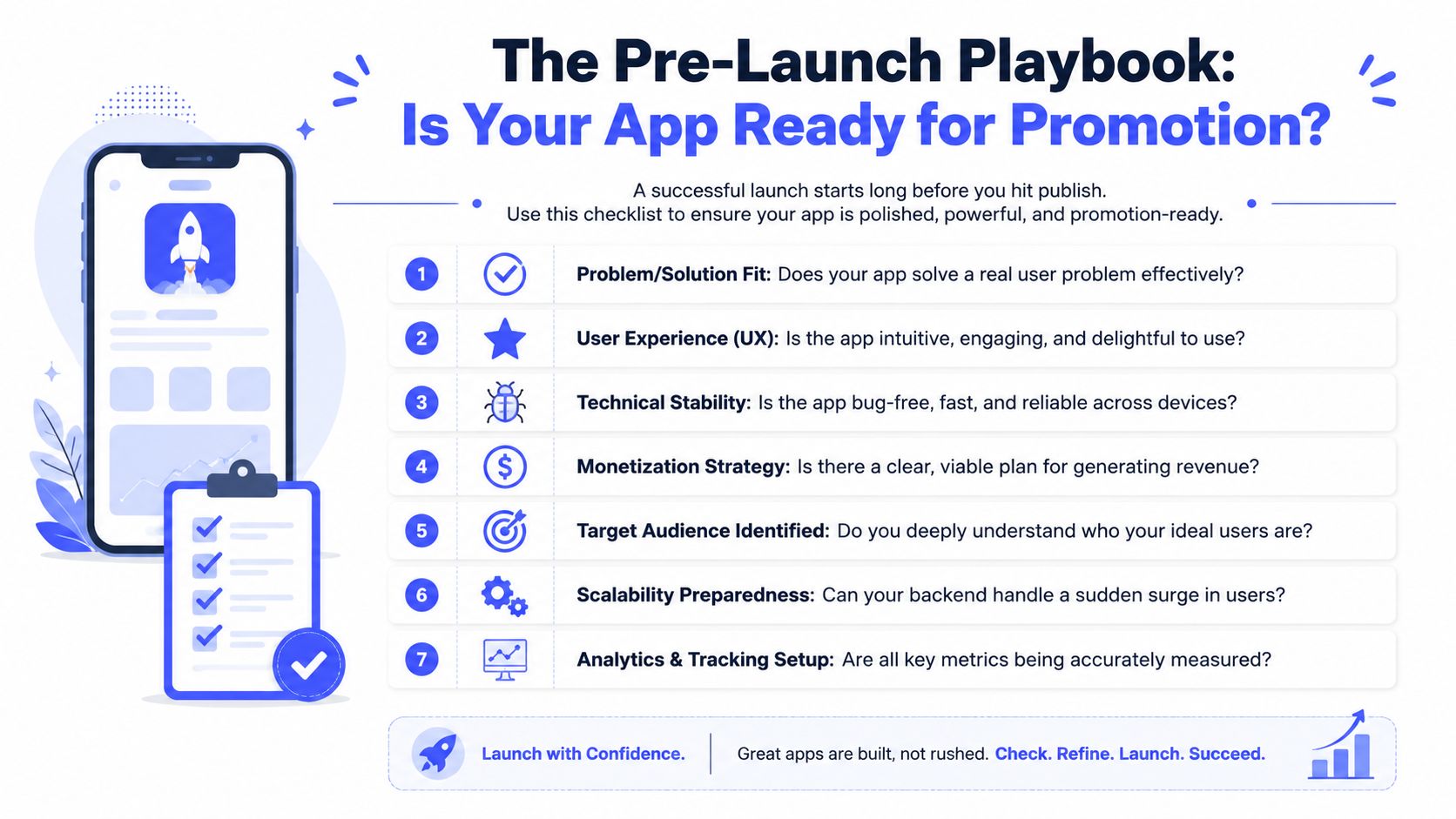
A readiness audit teams can actually use
Before launch approval, I'd want one shared review across product, UA, CRM, analytics, and creative. Not a slide deck. A decision document.
Use this internal audit:
- Value proposition clarity: Can the team explain the app's practical benefit without jargon? If the message needs too much setup, ads and store pages will underperform.
- Onboarding proof: Has the team watched real users move from install to first value moment? If users hesitate early, promotion will amplify drop-off.
- Notification logic: Are pushes tied to useful moments, not just calendar cadence? Users don't owe the app attention.
- Analytics integrity: Are install, registration, trial, purchase, subscription, retention, and churn events validated end to end?
- Creative truthfulness: Do the first ads and screenshots reflect the experience users get after install?
- Cross-functional ownership: Does each team know who approves copy, metadata, pricing changes, event schemas, and launch timing?
- Infrastructure readiness: Can support, backend, and release management handle a surge in new users without scrambling?
A simple decision table helps keep this objective:
| Area | Green light looks like | Red flag |
|---|---|---|
| Product | Clear user benefit and smooth first session | Utility is vague |
| Growth | Tracking and event mapping are reliable | Attribution disputes |
| Creative | Message and visuals match in-app reality | Ads promise features the app doesn't deliver |
| CRM | Lifecycle journeys are drafted | No post-install plan |
| Operations | Approval paths are clear | Teams are waiting on ad hoc signoff |
When teams skip this stage, mobile apps promotion turns into an argument about channel quality. Often the channel isn't the issue. The app wasn't ready to earn attention.
Building Your Organic Growth Engine
Organic growth compounds when the store page is treated like a live acquisition surface, not a static listing that gets updated once a quarter.
A practical ASO workflow is to validate keywords by relevance, competition, and search volume before placing them naturally into the product page. Expert guidance also recommends testing screenshots, icons, and copy systematically, then tracking downstream metrics like click-through rate, conversion rate, retention, churn, and user lifetime value instead of focusing only on installs, as outlined in this ASO and app measurement guide.
Treat the store listing as one conversion system

Too many teams split ASO into separate workstreams. One person owns keywords. Another owns screenshots. Design updates the icon during a rebrand. Nobody owns the conversion system as a whole.
That's not how users evaluate apps. They see a title, icon, rating context, screenshots, and description in one compressed decision moment. Your workflow should mirror that reality.
A strong operating pattern looks like this:
Start with user language
Pull language from reviews, support tickets, sales calls, community posts, and onboarding surveys. The best metadata often comes from how users describe the problem, not how internal teams describe the product.
Filter keywords before writing
Relevance comes first. High volume with weak intent usually creates poor conversion. Difficulty matters because some terms are too contested to justify the effort. Search volume matters because obscurity doesn't scale.
Write for conversion, not stuffing
Natural placement beats repetition. Overstuffed titles and descriptions can weaken clarity and hurt trust.
Test page elements together
Screenshot order, icon style, and opening copy should be reviewed as a set. The listing usually carries most of the conversion burden.
Your store page isn't supporting paid traffic. It's deciding whether paid traffic becomes a user.
Inclusive discovery is part of growth
Accessibility is still underweighted in mobile apps promotion. That's a mistake, especially for broad-market, utility, and regulated products.
A large-scale analysis found that 23% of analyzed apps failed to provide accessibility metadata, as highlighted in this research on app accessibility gaps. That's not just a compliance concern. It affects discoverability, trust, and whether users can adopt the product once they land on the page.
For team workflows, this means ASO shouldn't end with metadata and screenshots. Add inclusive checks to the release process:
- Metadata accessibility: Make sure categories, labels, and descriptions help users understand the experience clearly.
- Screenshot readability: Check contrast, text density, and whether key benefits are readable on smaller devices.
- Localization quality: Translate intent, not just words. Poor localization reduces ranking relevance and weakens conversion.
- Older-device reality: Don't present performance expectations the app can't support across common user environments.
Community managers, PMMs, and product designers should all feed this process. Organic growth gets stronger when the app page sounds like the user, looks usable, and reflects the actual experience after install.
Architecting Paid Acquisition Campaigns at Scale
Paid acquisition breaks down when account structure grows faster than team process.
The fix isn't more hustle from media buyers. It's architecture. For paid mobile apps promotion, the practical workflow is to launch multiple creative variants at once, monitor CTR, conversion rate, and ROAS, then shift budget toward the winning ad sets while continuing to test new headlines, visuals, and calls to action. Expert guidance also recommends using downstream quality metrics such as day-7 retention instead of optimizing for CPI alone, based on this paid app promotion workflow.
Build for controlled testing
A clean campaign architecture makes performance easier to interpret. A messy one creates noise that teams mistake for insight.
For most app programs, I'd structure testing around three variables only:
| Layer | What changes | What stays stable |
|---|---|---|
| Audience test | Persona, lookalike, interest, geography | Creative family and bid approach |
| Creative test | Hook, visual style, CTA, angle | Audience definition |
| Scaling layer | Budget and expansion | Proven audience-creative pairing |
That sounds obvious, but teams sabotage themselves by changing all three at once. Then nobody can explain why an ad set won or lost.
A better launch checklist for paid teams:
- Define the audience hypothesis first: “High-intent productivity switchers” is useful. “Broad mobile users” is not.
- Launch creative in batches: Don't upload one hero ad and wait. Start with a family of variants designed to isolate message fit.
- Use a downstream quality gate: Hold spend to users who retain, subscribe, or complete the events your business cares about.
- Plan retargeting from day one: Acquisition isn't a one-time launch event. Paid programs need a path for reactivation and upsell.
Operational speed comes from templates and governance
As soon as you're managing multiple regions, products, or business units, the bottleneck moves from strategy to execution. Teams start copying campaigns by hand, rebuilding naming conventions, chasing asset approvals in chat threads, and fixing avoidable setup errors.
A templated operating model is more important than another media buying trick. Platforms built for bulk execution can standardize campaign structures, approved copy blocks, targeting logic, and QA steps across ad accounts. For teams launching across many accounts, bulk launching workflows are one practical way to reduce manual duplication while keeping permissions and setup consistent.
The same principle applies to internal collaboration. Creative ops should know which asset versions are approved. Media buyers should know which templates map to each market. Growth leads should be able to audit what changed, when, and by whom.
Later in the workflow, this kind of team cadence matters just as much as the campaign setup itself:
When paid acquisition scales well, the team isn't improvising in the ad manager. It's executing a repeatable system with clear ownership.
Developing a High-Tempo Creative Strategy
Creative performance doesn't stall because teams run out of ideas. It stalls because they can't turn ideas into testable assets fast enough.
That's why a creative strategy for mobile apps promotion needs an operating model, not just a creative brief. The goal is to produce structured variation without letting brand consistency, approvals, and asset management collapse under volume.
Move from ad ideas to a creative matrix
A single “winning ad” is fragile. Audiences fatigue, competitors adapt, and platform dynamics shift. Strong teams build a matrix that lets them generate and refresh variants deliberately.
One practical format is to combine four inputs:
- Hook angle: problem-first, aspiration, speed, trust, comparison, feature-led
- Visual frame: UI demo, creator-style explainer, testimonial, motion graphic, before-and-after workflow
- Copy lens: emotional, instructional, concise utility, offer-led
- Call to action: install now, start free, try the workflow, get back on track
That doesn't mean every cell in the matrix deserves equal effort. Some combinations will be weak on arrival. The point is to give designers, copywriters, PMMs, and media buyers a shared production map.
The best creative review isn't “Do we like this ad?” It's “What variable are we testing, and what did we hold constant?”
If your app team already produces webinars, demos, customer interviews, or founder clips, repurposing systems help fill the matrix faster. Resources on tools for video and podcast repurposing are useful here because they help teams turn long-form assets into multiple short-form creative inputs without rebuilding everything manually.
Create one workflow for creative and media
Creative strategy fails when the handoff is clumsy. Designers export files into folders with unclear versioning. Copy gets approved in docs. Media buyers rebuild ads from scratch. Then performance feedback arrives too late to inform the next batch.
A better model is one shared production rhythm:
Creative strategy defines the test thesis
Not “make five videos.” Instead: “test benefit-led hooks against anxiety-reduction hooks for lapsed planners.”
Design and copy produce modular assets
Build editable components that can be remixed, not one-off files tied to one campaign.
Media buying tags assets by variable
Every asset should be searchable by angle, audience fit, format, market, and approval status.
Performance feedback returns to the library
Winning hooks, weak intros, and stale visual treatments should all be documented, not left in someone's notes.
For teams that need this more formalized, a centralized creative library workflow can help keep approved assets, permissions, and reusable components in one place so testing doesn't depend on scattered files and ad hoc approvals. The primary gain isn't convenience. It's operational continuity across designers, copywriters, and buyers.
Measuring What Matters LTV ROAS and Optimization
Install growth is the easiest metric to overrate.
Teams can hit volume targets, keep CPI in range, and still buy users who never activate, never subscribe, and never return. That usually happens when channel managers optimize inside ad platforms, product teams review activation separately, and finance evaluates payback on a different timeline. The reporting gap becomes the strategy gap.
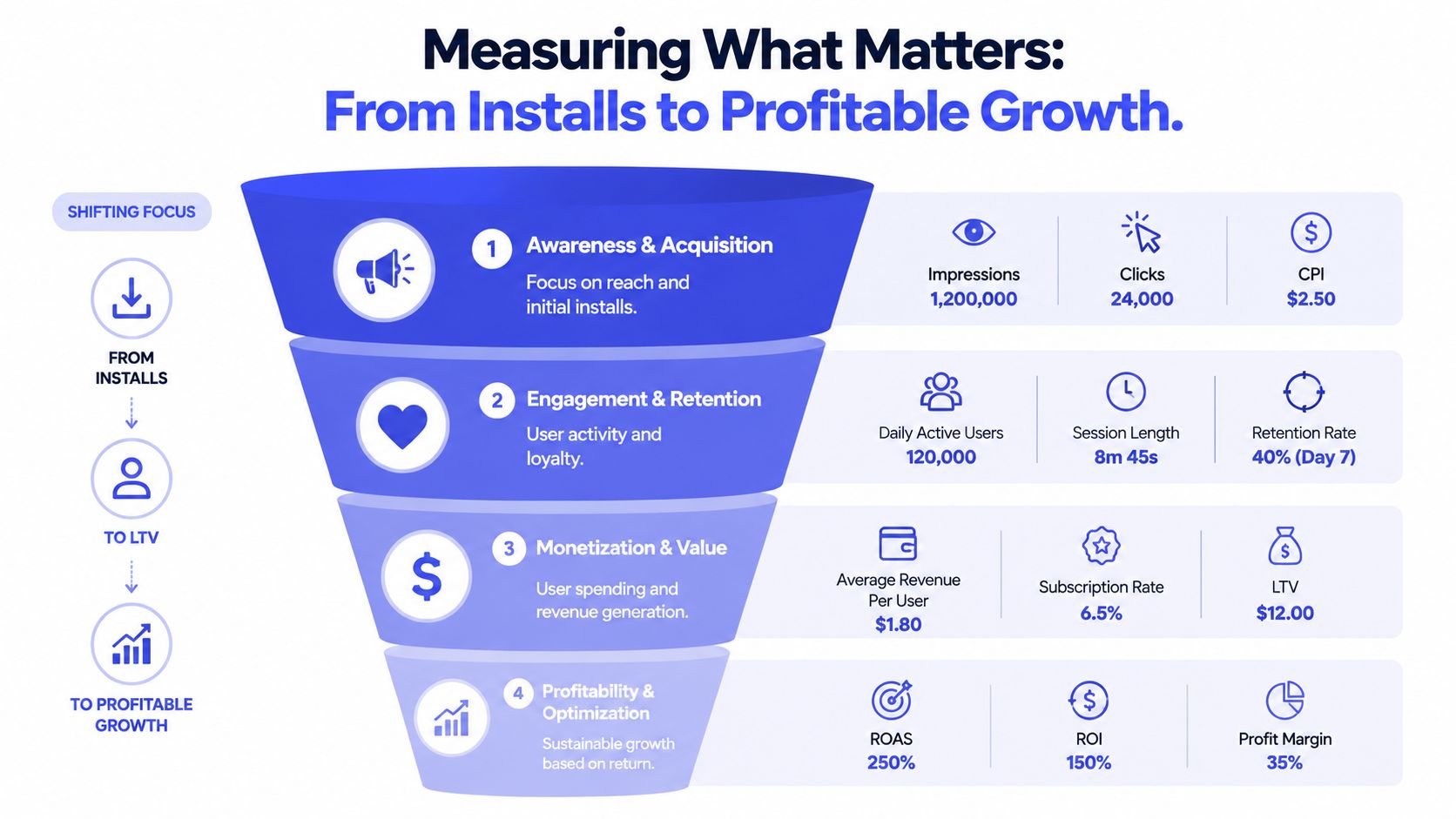
The fix starts with a measurement model that follows the user from click to revenue:
| Stage | Primary question | Metrics that help |
|---|---|---|
| Acquisition | Are we buying qualified attention? | CTR, conversion rate |
| Activation | Do new users reach value quickly? | Key event completion |
| Retention | Do they come back? | Retention, churn |
| Monetization | Do they generate revenue? | Subscription conversion, purchase events, LTV |
| Efficiency | Is spend producing return? | ROAS |
The trade-off is speed versus truth. Install data arrives fast, so teams act on it first. LTV and retained revenue take longer to mature, so weak traffic often gets more budget than it deserves. Good operators close that delay with proxy metrics that correlate with value, such as first key action, trial start, or day-7 retention by source.
One rule keeps teams out of trouble. If a campaign beats CPI targets but misses activation, retention, or monetization thresholds, it is not a winner.
Build one reporting layer teams can trust
Measurement breaks down when every team owns one part of the funnel and none of them share definitions. Marketing reports attributed installs. Product reports activated users. Finance reports recognized revenue. Analytics reports cohorts with a different lookback window. The result is familiar. Budget reviews turn into reconciliation meetings.
A workable system defines a few things upfront: attribution source, event naming, revenue logic, cohort windows, refresh cadence, and who signs off on metric changes. That sounds operational because it is. Scale depends on governance as much as targeting.
This is also where automation matters. At a certain spend level, manual exports and spreadsheet stitching slow decisions, create version conflicts, and make it harder to explain why one team scaled while another paused. A centralized layer for Facebook ads reporting workflows helps teams monitor shared KPIs, standardize launch reporting, and reduce the back-and-forth that shows up every time performance shifts.
Koast is useful in that operating model because the core issue is rarely ad setup alone. The harder problem is keeping creative, media, analytics, and approval workflows aligned as volume grows across markets and channels.
The same discipline applies to upper-funnel content. Teams working across paid social, creator distribution, and brand media can use this guide to boosting content impact to connect content spend back to business outcomes instead of treating engagement as the finish line.
Optimization gets better when the review process is strict and repeatable:
- Pause campaigns that miss downstream quality thresholds, even if top-of-funnel costs look efficient
- Scale only after cohorts show acceptable retention or monetization, not just cheap installs
- Review performance by source, audience, creative angle, and geo so weak pockets do not hide inside blended reporting
- Refresh creative on a planned cadence so fatigue does not distort spend allocation
- Document changes in one place so product, finance, and acquisition teams can audit what happened and why
When that operating rhythm is in place, LTV and ROAS stop sitting in monthly finance decks. They become the metrics teams use to decide what to launch, what to cut, and where to put the next dollar.
Driving Retention and Profitable Re-Engagement
Most acquisition teams still treat post-install marketing as someone else's job. That leaves a lot of value on the table.
The strongest mobile apps promotion programs keep spending after install, but they spend differently. They coordinate CRM, product messaging, and paid retargeting around user behavior instead of treating every inactive user as equally worth winning back.
Retention deserves paid and owned coordination
Retention starts with message relevance. If a user hasn't experienced the app's core value, a generic push won't fix that. If a subscriber is drifting, a broad paid retargeting ad may be less effective than an in-app prompt tied to a meaningful feature or benefit.
A practical lifecycle rhythm usually includes:
- Onboarding prompts: Guide users to the first meaningful action, not every feature.
- Contextual in-app messaging: Surface the next best action while the user is active.
- Useful push notifications: Send reminders tied to user goals, not internal calendar pressure.
- Paid retargeting: Reintroduce the app when the user has enough prior intent to justify media spend.
The important team point is ownership. CRM managers shouldn't build journeys in isolation, and media buyers shouldn't retarget lapsed users without knowing what messages they've already seen inside the product.
Re-engagement works best when it is selective
Not every inactive user is a good re-engagement candidate. Some never found value. Some churned because the product wasn't a fit. Others need a well-timed reminder tied to the reason they installed in the first place.
A better segmentation model separates users by prior value and current intent:
| Segment | Better response |
|---|---|
| New users who stalled early | Product education and onboarding support |
| Former active users | Feature-led reminders or progress-based prompts |
| Prior payers or subscribers | Personalized win-back offers and retargeting |
| Low-intent inactive users | Limited paid spend, stronger suppression logic |
Plainly put, profitable re-engagement is about restraint. Teams should earn the return visit with relevance.
Existing users already told you something valuable by installing once. Re-engagement works when you use that history intelligently instead of broadcasting the same comeback message to everyone.
Koast fits into this operating model as a practical option for teams managing high-volume Meta execution. It centralizes campaign launching, creative organization, permissions, and automation so media buyers, creative teams, and growth leads can work from the same system instead of juggling tabs, spreadsheets, and duplicated setup across accounts.