Your Facebook ad account probably isn't failing because the team lacks ideas. It's failing because five people are making changes from five different places, nobody agrees on the primary KPI, and the creative pipeline can't keep pace with media spend.
That's the enterprise version of ad optimization Facebook teams deal with. One manager wants lower CPA. The creative lead wants more time to produce better concepts. The analyst doesn't trust attribution. The client partner wants faster scaling. Meanwhile, media buyers are buried in tabs, duplicating campaigns, renaming assets, and trying to remember which audience test was supposed to isolate which angle.
The fix isn't another loose checklist. It's an operating model. You need one playbook that ties KPI ownership, experiment design, creative governance, automation rules, and measurement hygiene into a shared workflow. Teams that treat Facebook optimization as a solo media buying craft hit a ceiling fast. Teams that run it like a coordinated operating system scale without losing control.
Table of Contents
- Introduction to Collaborative Facebook Ad Optimization
- Start with one KPI charter
- Use a practical RACI for Facebook ads
- Build reporting into the workflow
- Stop calling rushed edits testing
- Use checkpoints that force collaboration
- Keep the test matrix readable
- Separate angles before you separate audiences
- Run a weekly creative review that media can actually use
- Control variation sprawl
- Send qualified outcomes back to Meta
- Use an incident process instead of Slack chaos
- Troubleshoot in a fixed order
Introduction to Collaborative Facebook Ad Optimization
A global growth team launches campaigns across several business units. Creative sits in one system, media planning sits in another, approvals happen in chat, and naming conventions live in somebody's head. By the time spend ramps, the original test plan is already compromised.
That's common, especially when enterprise teams manage multiple accounts, regional variations, and separate stakeholders for paid social, brand, analytics, and compliance. The platform itself is powerful, but the operating model around it is often sloppy. That's where wasted spend comes from.
Facebook remains too important to manage casually. A 2026 performance summary notes that Meta generated $201 billion in revenue with 22% year over year growth, that Facebook ads generated 195 billion ad impressions per month globally, and that marketers reach an average of 2,520 users for every $10 spent on Facebook ads, according to Meta advertising performance data for 2026. The scale is enormous. So are the consequences of poor team coordination.
If you're running ecommerce, lead gen, or subscription offers, the problem usually isn't access to opportunity. It's operational drag. Teams lose time rebuilding briefs, re-uploading creatives, and reconciling conflicting reports. Even specialists working on adjacent use cases like optimizing Facebook ads for POD run into the same issue. Performance improves when product, creative, media, and ops work from the same system of record.
Collaborative optimization beats heroic media buying. The best Facebook accounts are usually the best-run teams.
Aligning KPIs Goals and Team Responsibilities
Most ad accounts don't have a performance problem first. They have a definition problem. People say “efficiency” and mean different things. People say “scale” and mean different things. That confusion turns every weekly review into a debate instead of a decision.
Start with one KPI charter
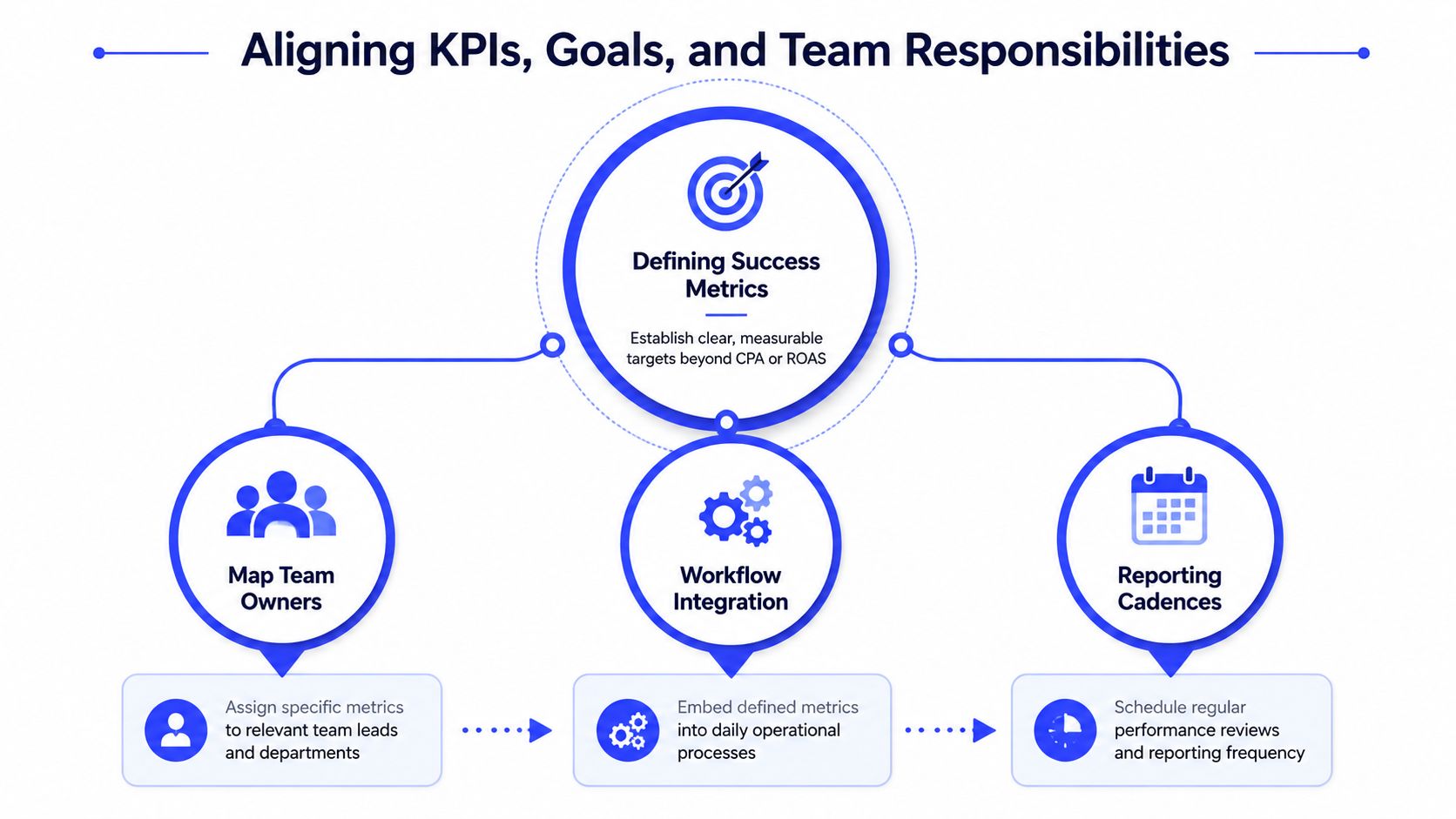
Create a KPI charter and force every stakeholder to sign off on it. Keep it short. If it runs longer than a page, nobody will use it.
The charter should define:
- Primary business outcome: The metric that decides whether the campaign is working.
- Secondary delivery metrics: CTR, CPC, conversion rate, reach, and frequency only if they support diagnosis.
- Quality metrics: The downstream signal that tells you whether cheap conversions are actually useful.
- Review cadence: Daily operational review, weekly team review, monthly stakeholder review.
- Decision owner: One person who breaks ties.
Facebook benchmarks can look healthy while business quality slips. In 2026, Facebook leads campaigns averaged a 2.59% CTR and a 7.72% conversion rate, while traffic campaigns averaged a 1.71% CTR and $0.70 CPC, according to Sprout Social's Facebook stats for marketers. Useful benchmarks, yes. But they don't replace an internal definition of what counts as a good lead, a qualified signup, or a high-value purchase.
Use a practical RACI for Facebook ads
A RACI framework sounds bureaucratic until you've watched three teams overwrite each other's work. Then it becomes necessary.
Here's the version I'd use for enterprise ad optimization Facebook programs:
| Workstream | Responsible | Accountable | Consulted | Informed |
|---|---|---|---|---|
| KPI definitions | Marketing ops | Growth lead | Finance, sales | Creative, media |
| Creative briefs | Creative strategist | Creative lead | Media buyer, product marketing | Ops |
| Campaign build | Media buyer | Paid social lead | Ops, analytics | Creative |
| Tracking validation | Data engineer | Marketing ops | Analytics, media | Leadership |
| Budget changes | Media buyer | Paid social lead | Ops | Finance, client lead |
| Access and permissions | Governance admin | Marketing ops | Security, team leads | All users |
The point isn't formality. The point is speed. When performance drops, you shouldn't need a meeting to determine who checks the event stream, who audits the audience logic, and who approves a creative refresh.
Practical rule: If a KPI has no owner, it won't improve. If a workflow has no approver, it will drift.
Enterprise teams also need enough creative volume to support optimization. LeadsBridge's Meta ads best practices notes that enterprise teams must maintain 15–50+ active creatives at the same time to prevent algorithmic fatigue and preserve signal density. That only works when creative, media, and governance teams run coordinated weekly production cycles. You need a shared asset library, naming standards, and permission controls so content teams can approve variants while media buyers launch without constant back-and-forth.
Build reporting into the workflow
Don't build reports as a separate activity. Build them into the process that creates campaigns.
A good weekly scorecard should answer only four questions:
- What changed?
- Did the change improve the primary KPI?
- Did lead quality or revenue quality move with it?
- What decision gets made today?
I'd also standardize a weekly workshop agenda:
- First 10 minutes: KPI review against target and variance.
- Next block: Creative readout from the content lead.
- Then: Media delivery review and test status.
- After that: Tracking issues, anomalies, or governance exceptions.
- Final segment: Decisions with owners and deadlines.
That workshop works because it mirrors how the account operates in practice. It also prevents a common failure mode. Teams drown in reports, but nobody leaves with actions.
Structuring Experiments for Reliable Results
Bad testing discipline is one of the fastest ways to waste Facebook budget. Teams launch two ad variants, watch half a day of data, and start editing budgets, headlines, and audiences all at once. That isn't optimization. It's random motion.
Stop calling rushed edits testing
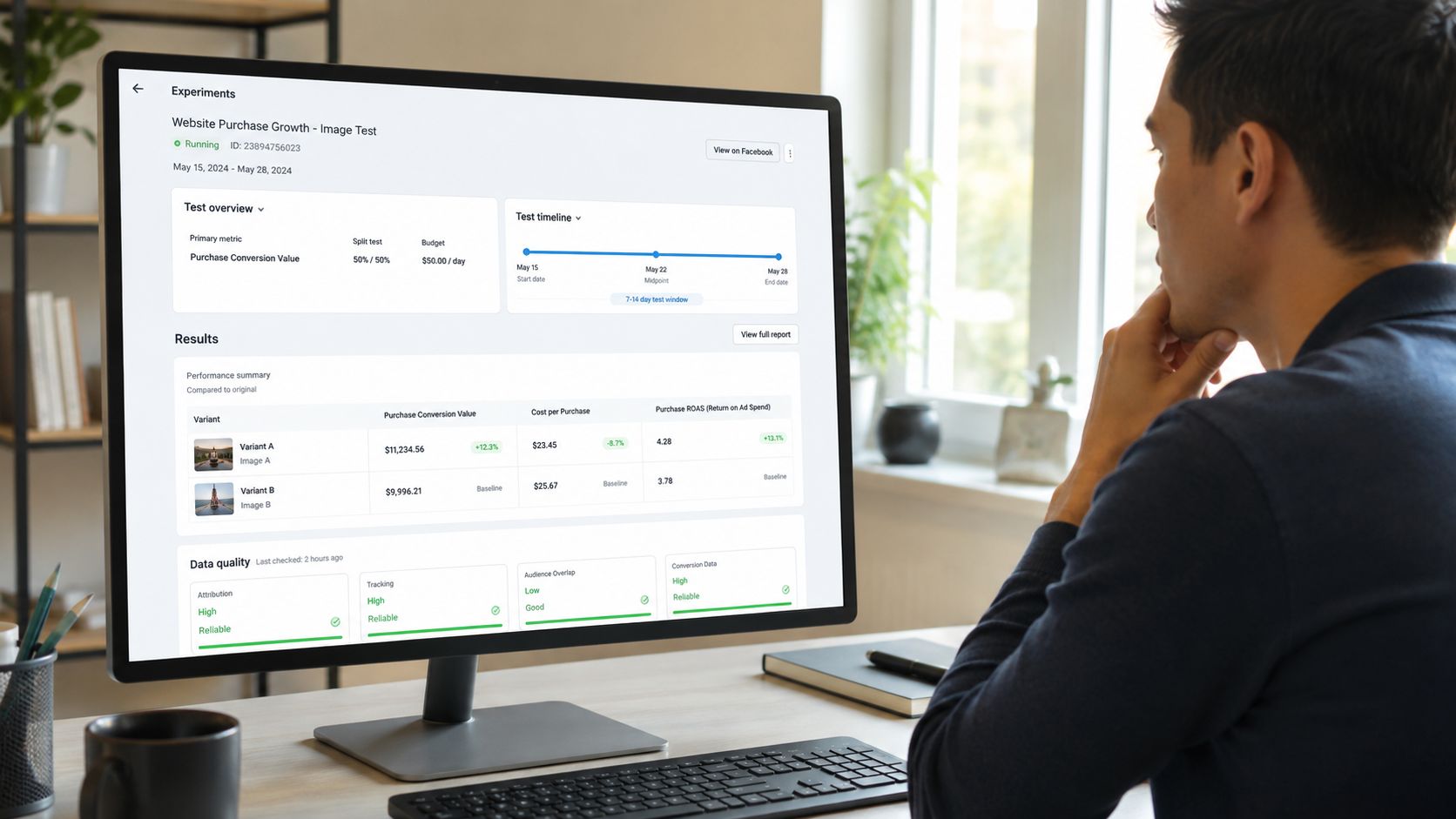
A real experiment needs a stable setup, clear variable control, and enough time for the platform to learn. Madgicx's guide to Facebook conversion optimization states that statistical significance requires a minimum testing timeline of 7–14 days to account for learning curves and outside variables. The same source notes that incomplete server-side tracking can lead to a 30% reduction in optimization accuracy.
That means two things.
First, stop judging winners too early. Second, stop testing on weak data. If your Meta Pixel and Conversions API setup isn't deduplicating correctly with Event ID management, your experiment readout is contaminated before the first result arrives.
Use checkpoints that force collaboration
The best experiment structure is boring on purpose. It removes excuses for impulsive changes.
Use this operating rhythm:
- Creative lead approves assets and naming.
- Media buyer confirms only one major variable is changing.
- Data engineer validates Pixel and CAPI event flow.
- No edits unless there's a technical fault.
- Analyst checks event integrity, not performance conclusions.
- Media buyer monitors trend direction.
- Creative lead flags comments or qualitative feedback patterns.
- Team reviews decision-ready data.
- Ops records whether to scale, iterate, or kill.
A shared testing calendar helps. So does a single dashboard view with campaign objective, test variable, launch date, owner, and current status. If you want a framework for applying AI to that process, this guide on AI A/B testing strategies for ad success is useful for structuring variation review without turning every experiment into a free-for-all.
Don't let media buyers own testing alone. Analysts should validate data quality, and creative leads should verify that the winning asset actually reflects the intended angle.
Keep the test matrix readable
You don't need a giant experimentation lab. You need readability.
I recommend a simple test matrix with these columns:
| Test ID | Objective | Variable under test | What stays fixed | Owner | Launch date | Earliest review date | Decision |
|---|
The biggest testing mistake at scale isn't lack of creativity. It's changing too many things at once. Once budget, creative, and targeting all shift together, nobody can explain the outcome. And if nobody can explain the outcome, nobody can repeat the win across accounts.
Use a shared rule: one test, one hypothesis, one owner.
Optimizing Creative and Audience Segmentation
Teams often segment audiences too early and isolate creative angles too late. That's backwards.
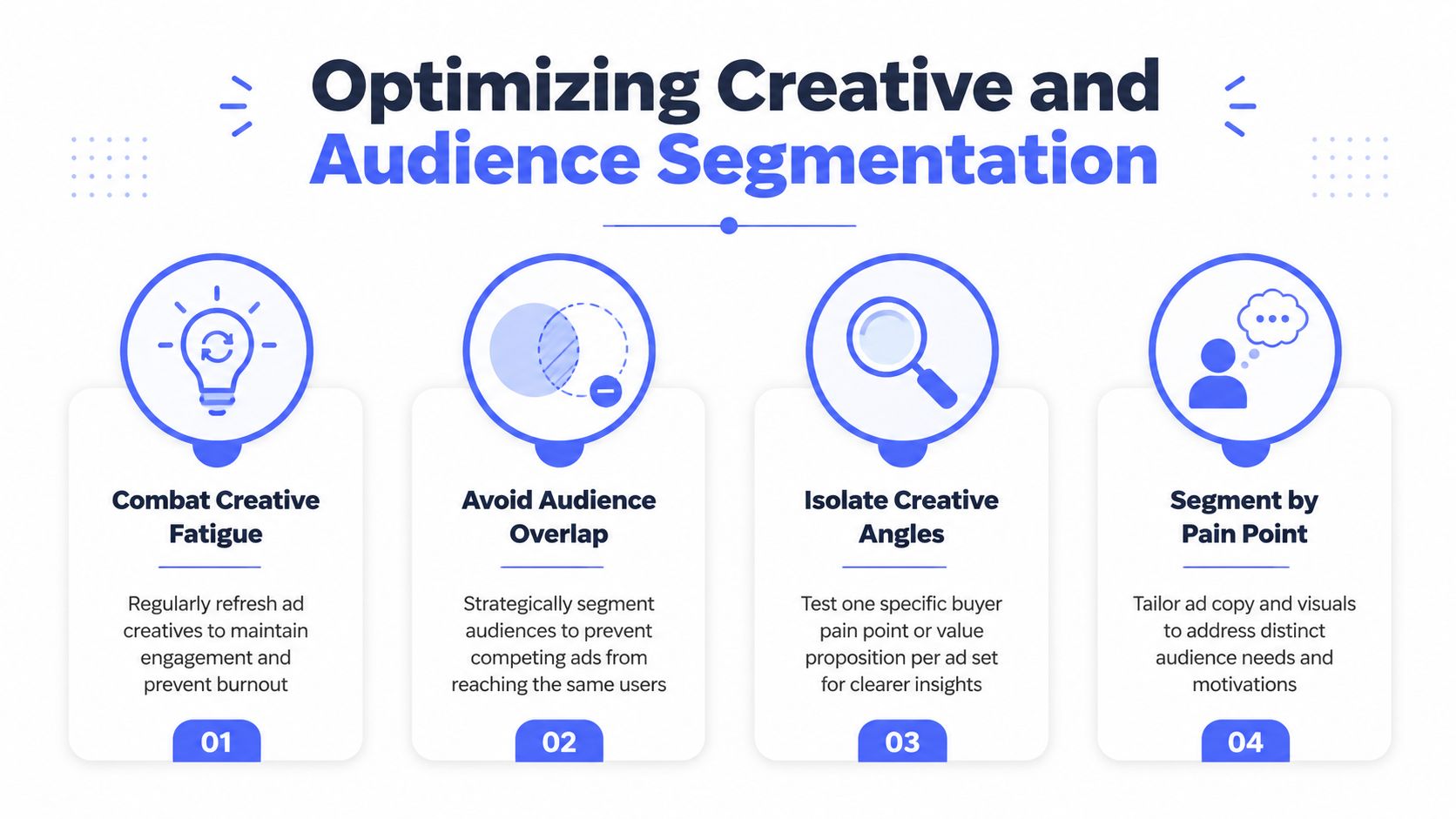
When Facebook performance slips, people often react by stacking more interests, carving smaller lookalikes, or adding layers of exclusions. That can make reporting look more deliberate, but it often muddies the signal. The stronger move is usually cleaner creative angle isolation with broader audience delivery.
Separate angles before you separate audiences
Aimers' Facebook ads optimization analysis makes the trade-off clear. Campaigns using broad audiences with strong, pain-point-specific copy outperform stacked interest campaigns by 22% in ROAS, but only when each ad set tests one buyer problem per claim rather than mixing multiple hooks under the same angle.
That's the part many teams miss. Broad targeting only works cleanly when the creative structure is disciplined.
If you're selling B2B software, don't combine “save time,” “reduce errors,” and “improve visibility” in the same ad set and then pretend you learned something. You didn't. You learned that Meta found some people who responded to some mix of those ideas.
Run a weekly creative review that media can actually use
Creative review meetings often collapse into taste discussions. Fix that by reviewing angles, not aesthetics.
Use a recurring agenda like this:
- Angle performance: Which buyer problem did each ad set represent?
- Hook quality: Which opening lines held attention and which ones died quickly?
- Conversion quality: Did the angle drive qualified outcomes or just cheap clicks?
- Rotation decision: Refresh, expand, or retire.
That last point matters because short-term engagement can mislead teams. Leadenforce's analysis of creative angles notes that teams measuring qualified leads and closed-won outcomes instead of CTR alone identify 30-40% more profitable angles. The operational takeaway is simple. Creative reporting has to include downstream quality, not just top-of-funnel response.
For teams trying to systematize audience work alongside creative testing, this walkthrough on AI tools for Facebook ad audiences is a practical complement to angle-based review.
Control variation sprawl
More variants aren't always better. Undisciplined variation creates noise.
Modern Marketing Institute's advanced Meta ads strategies notes that Meta recommends limiting Dynamic Creative Optimization ads to no more than 5 variations per component, and starting with 3–4 per component to keep combinations manageable. That's a governance issue as much as a creative one.
Use these controls:
- Approved copy limits: Content admins define how many headlines, primary texts, and visuals are allowed before launch.
- Asset performance review: Media and creative teams review component breakdowns together, not separately.
- Library discipline: Retire losing assets clearly. Don't let old variants clutter future test pools.
A creative library isn't just storage. It's a decision system. If your team can't tell which angle, hook, and asset combination won, your library is disorganized.
Implementing Automation Rules for Scaling and Protection
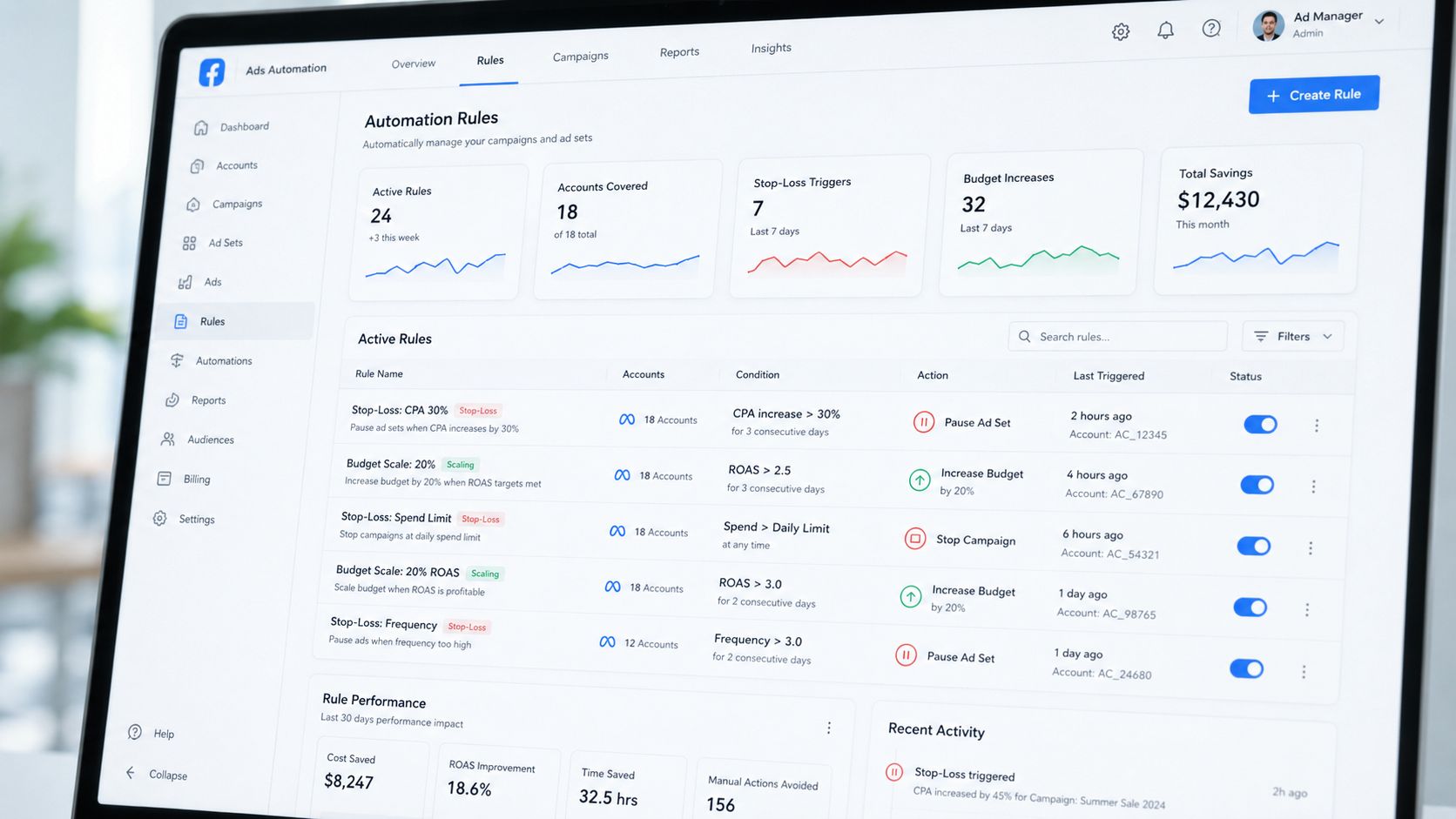
Once your campaign structure is sound, manual optimization becomes the bottleneck. Enterprise teams can't rely on somebody noticing performance drift in a dashboard and making edits by hand. That's too slow and too inconsistent.
The first job of automation isn't scaling. It's protection.
Automate the guardrails first
Set rules that stop obvious waste before you touch growth logic.
I'd implement these in order:
Tracking fault alerts
If key events stop firing or suddenly diverge from backend trends, pause decision-making and route the issue to ops and engineering.Stop-loss controls
Define when an ad set or campaign should pause based on your internal efficiency thresholds and quality criteria.Creative fatigue review triggers
Flag assets for review when engagement quality softens or delivery starts concentrating too narrowly.Budget scaling rules
Only after the account proves stable.
Effective workflow is essential. Ops should own rule logic and logging. Media buyers should propose thresholds. Governance admins should control publishing permissions. If everyone can edit automation freely, the account becomes impossible to audit.
Scale budgets without breaking delivery
Aggressive budget changes are one of the easiest ways to wreck a winning campaign. AdStellar's guidance on optimizing Facebook ads recommends increasing daily budgets by no more than 20% every 48–72 hours, followed by a 48-hour settlement window to watch for deterioration.
That's the rule I'd use unless there's a clear reason not to.
Here's the practical workflow:
- Media buyer: Flags campaigns eligible for scale.
- Ops lead: Confirms rule conditions and verifies no major concurrent changes are planned.
- Creative lead: Confirms the active asset pool is healthy enough to support more spend.
- Analyst: Monitors post-scale efficiency and downstream quality during the settlement window.
The trade-off is obvious. Slower scaling protects stability. Faster scaling can buy speed, but it also resets learning and muddies attribution. There is frequently an overemphasis on speed because it feels decisive. In practice, disciplined scaling wins more often.
A short explainer on the mechanics helps teams align before they automate at account level:
Document every rule change
The minimum governance layer is a change log with:
| Date | Rule changed | Who changed it | Why | Accounts affected | Review date |
|---|
If you're managing many accounts, use one automation platform or one central ops process to keep that log clean. Meta's native rules can work. So can a dedicated execution layer. Koast is one example of a platform that centralizes campaign launching, creative libraries, role-based permissions, KPI tracking, and automated optimization workflows across multiple ad accounts. The important part isn't the vendor. It's having one place where launches, rule edits, and ownership are visible.
Without that visibility, automation creates hidden risk instead of advantage.
Measurement Attribution and Troubleshooting
A lot of Facebook optimization advice assumes your measurement setup is trustworthy. In enterprise environments, that assumption is usually wrong.
Lead forms sync late. CRM stages change names. Offline conversions don't pass back cleanly. Event deduplication breaks. Then teams argue about media performance when the underlying problem is data plumbing.
Send qualified outcomes back to Meta
If you optimize toward low-quality form fills, Meta will find more low-quality form fills. That isn't a platform problem. It's an input problem.
Great Marketing's Meta ads best practices argues that enterprise-scale optimization requires passing offline conversion data back through the Conversions API so Meta can train on qualified outcomes instead of unqualified submissions. It also makes the organizational point many teams ignore. Marketing ops, IT, and data engineers have to work together on the setup.
That's why attribution governance should include:
- Event dictionary ownership: One team defines event names and qualification logic.
- CRM stage mapping: Sales and ops agree on which downstream events matter.
- CAPI validation: Engineers and analysts verify payload quality and deduplication.
- Feedback loop review: Media and ops confirm that qualified outcomes are being passed back.
If your team needs a reference point for the technical side, this guide to Meta Conversions API implementation is a useful starting resource.
Use an incident process instead of Slack chaos
When reporting breaks, informal debugging is the default approach. Somebody posts screenshots. Another person checks Events Manager. A third person says the CRM looks fine. Hours disappear.
Use an incident log instead.
| Incident | Detected by | Suspected issue | Immediate action | Owner | Status |
|---|
Then set an escalation path:
- Analyst identifies the discrepancy.
- Marketing ops checks whether the issue is platform-side, implementation-side, or reporting-side.
- Data engineer validates event flow and duplication.
- Media team freezes major optimization decisions until integrity is restored.
- Stakeholders get one status update, not ten scattered messages.
That process sounds rigid. Good. Rigid processes prevent expensive decisions based on broken data.
Troubleshoot in a fixed order
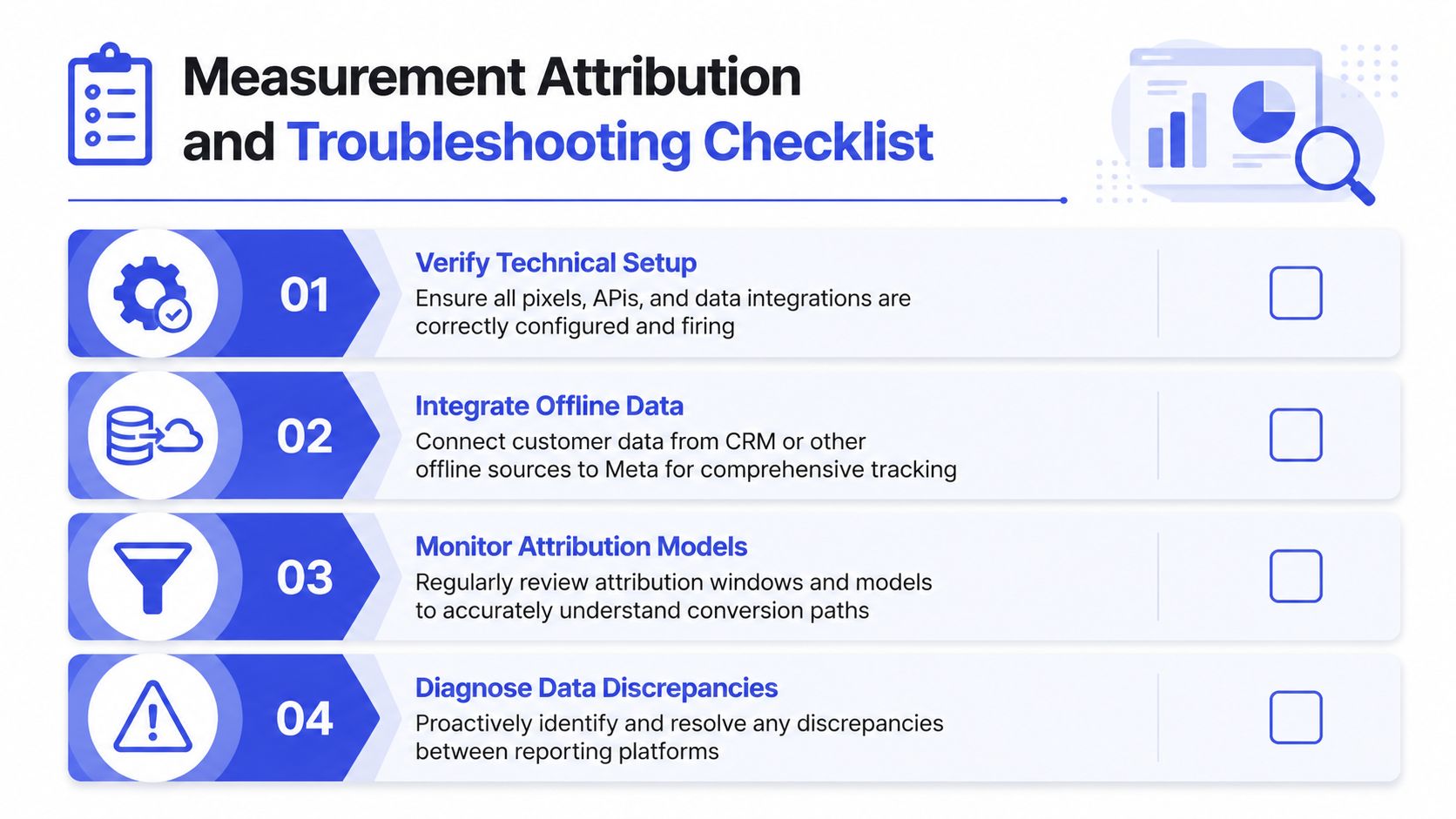
Teams waste time when they troubleshoot from the wrong end. Start with signal integrity, then move outward.
Use this order:
- First, verify technical setup. Check whether Pixel and server-side events are firing as expected.
- Next, compare qualified and unqualified outcomes. Make sure the optimization target still reflects business value.
- Then, inspect attribution logic. Confirm the reporting window and downstream match process still fit your sales cycle.
- Finally, review ad fatigue and execution drift. Once data is trustworthy, then look at media causes.
Broken attribution makes smart media buyers look reckless. Clean attribution makes average media buyers look smarter than they are.
Actionable Next Steps for Enterprise Teams
If your team wants better Facebook performance, don't start by asking for more tests or more automation. Start by tightening operations.
Put these actions into your standard operating procedure this month:
- Lock KPI definitions: One charter, one owner, one weekly scorecard.
- Enforce test discipline: No major decisions before the planned review window unless there's a technical problem.
- Run weekly creative operations: Review angles, not just assets, and connect results to downstream quality.
- Set controlled automation: Use stop-loss logic first, then scale budgets with strict review windows.
- Fix signal quality: Route qualified offline outcomes back into Meta and assign ownership for troubleshooting.
The biggest improvement usually comes from removing ambiguity. When teams know who owns the KPI, who approves creative, who validates tracking, and who can edit automation, performance gets easier to improve and easier to defend.
Roll the playbook out account by account. Don't try to redesign the entire organization in one sprint. Start with one market, one business unit, or one client pod. Build the templates, test the review cadence, and standardize the governance log. Then expand.
Ad optimization Facebook teams can trust isn't built on hacks. It's built on repeatable team habits.
If your team is tired of tab-heavy Meta workflows, Koast is worth a look. It gives agencies and enterprise growth teams a centralized way to launch campaigns, manage creative libraries, apply role-based permissions, monitor KPIs, and automate optimization across multiple ad accounts without losing governance.