Teams frequently state a desire to optimize for conversions. Fewer teams can answer a harder question: which conversion deserves optimization?
That gap is where wasted spend hides. A campaign can post a healthy front-end conversion rate and still send sales a pipeline full of low-intent leads, weak-fit customers, or purchases that don't hold margin. In enterprise paid social, that problem gets worse because media buyers, analysts, creative strategists, and web teams often work from different definitions of success.
The fix isn't another generic CRO checklist. It's a shared operating model. The teams that scale paid social profitably align measurement, creative angles, traffic quality, landing pages, and automation around a conversion event that reflects downstream business value, not just platform convenience.
Table of Contents
- Choose the conversion event before you touch the campaign
- Build one reporting language for the whole team
- Automate only after the decision logic is clear
- Build workflows that protect budget and speed up action
Moving Beyond Rate to Optimize for Conversion Quality
A lot of advice about how to optimize for conversions still assumes that more conversions equals better performance. That works only if every conversion has roughly the same business value. In practice, they don't.
Experienced marketers increasingly need to optimize for conversion quality and downstream value instead of raw form fills, especially when traffic source, audience intent, and margin structure differ across campaigns, as noted in Wellspring Digital's discussion of micro-conversions and business outcomes. A cheap lead can be expensive once sales touches it. A lower-volume purchase event can be far more useful than a high-volume lead event if it tells the platform who your real buyers are.
That changes how teams should evaluate campaign performance. Media buyers shouldn't judge success from platform conversion rate alone. Analysts shouldn't report on blended CPA without separating conversion types. Leadership shouldn't ask for more leads if the actual constraint is low close rate or weak order quality.
Practical rule: If sales wouldn't celebrate the conversion, paid social shouldn't optimize around it by default.
For enterprise teams, a shared decision framework is essential. Before anyone launches tests, the team should answer four questions:
- What outcome matters most: lead submission, qualified lead, purchase, booked demo, or another event tied to revenue.
- What signal the ad platform can reliably learn from: some events are more valuable, but too sparse to support stable optimization in every account.
- What the sales or retention team sees after the click: conversion quality problems usually appear downstream first.
- What trade-off the business accepts: lower volume with stronger quality, or more scale with looser qualification.
Choose the real business conversion
The biggest mistake isn't choosing the wrong CTA. It's choosing the wrong optimization event.
If you're running paid social across multiple offers, geographies, or funnels, one “sitewide conversion” target usually hides more than it reveals. A direct-response ecommerce campaign may belong on purchase. A longer sales cycle may need a proxy event first, but only if that proxy maps closely to qualified pipeline.
Teams waste months “improving” conversion rate when the real issue is that they optimized the easiest event to capture, not the event that predicts profit.
The practical shift is simple. Stop asking, “How do we raise conversion rate?” Start asking, “How do we get the platform, the landing page, and the team to produce more of the conversions the business values?”
Foundation First Aligning Your Measurement and Goals
Bad measurement creates fake winners. Good measurement lets teams move fast without arguing over what happened.
A solid baseline helps frame what “good” even means. The average website converts about 2.35% of visitors, while top-quartile sites convert at 5.31% or higher. Paid search benchmarks are higher at 4.8% to 6.11%, which is why channel-specific benchmarking matters when setting targets, as summarized in these conversion optimization benchmarks. Don't take a paid search benchmark and force paid social to answer to it. Different traffic arrives with different intent.
Choose the conversion event before you touch the campaign
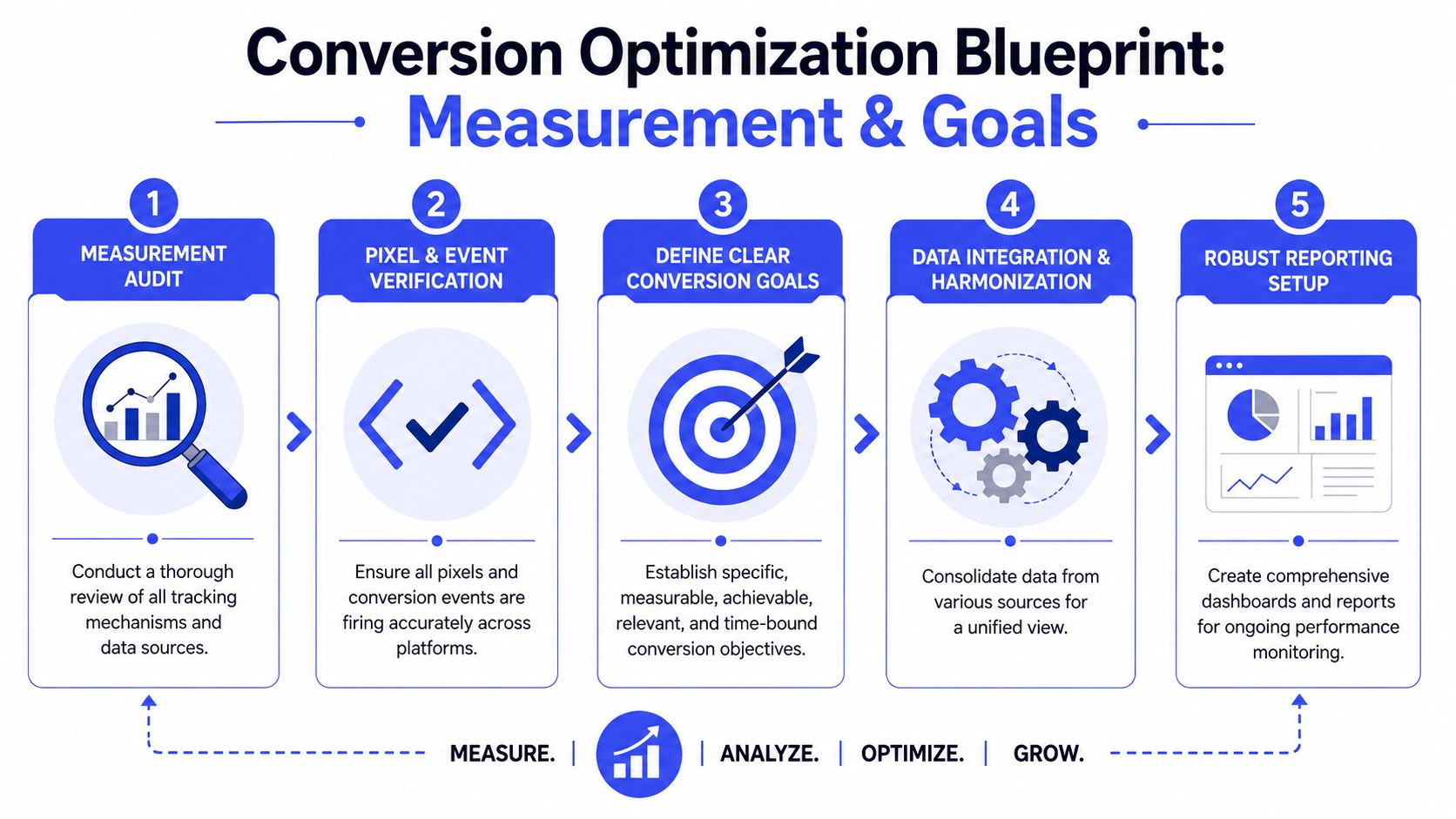
Start with an audit that goes beyond “the pixel fires.” The team needs to verify event definitions, attribution logic, naming consistency, and ownership.
A useful sequence looks like this:
- List every tracked conversion event. Include platform events, CRM stages, and offline outcomes.
- Rank them by business importance. Separate reporting events from optimization events.
- Check reliability. If the event is noisy, duplicated, delayed, or inconsistently passed back, it's a weak foundation.
- Map ownership. Media, analytics, CRM, and web teams should each know what they maintain.
For many teams, this is also the point to tighten server-side tracking and event quality. The exact stack will vary, but the principle doesn't. If your signal is fragmented, your optimization will be fragmented too.
Build one reporting language for the whole team
Enterprise accounts break when every function uses its own dashboard. Media sees cost per result. Sales sees lead quality. Finance sees margin. Leadership sees blended return. None of those are wrong, but they create misalignment if they aren't tied together.
A shared reporting model should include:
| Team | Primary lens | What they need to see |
|---|---|---|
| Paid media | Delivery and efficiency | Spend, conversion event, CPA or value trend, breakdown by campaign and audience |
| Creative | Message performance | Angle, hook, format, landing page match, conversion quality by concept |
| Analytics | Signal integrity | Event quality, attribution consistency, segmentation by device and source |
| Leadership | Business outcome | Qualified pipeline, purchases, or another agreed primary result |
One practical fix is to standardize naming conventions and approval workflows before campaigns launch. That gives reporting structure from day one instead of forcing retroactive cleanup. Teams that need cleaner stakeholder visibility can also use Facebook ads reporting workflows that consolidate KPIs across accounts so media, operations, and leadership aren't pulling different numbers from different views.
When a campaign underperforms, the first meeting shouldn't be about whose dashboard is right.
The win here isn't just cleaner data. It's speed. When everyone agrees on the goal and trusts the measurement, the team can spend less time debating attribution and more time fixing the actual bottleneck.
Ideate and Test Winning Creative Angles at Scale
Most losing campaigns aren't killed by button color, headline length, or minor copy edits. They fail because the angle is weak.
Many guides still under-explain how to choose the winning angle before testing creative. Conversion problems are often blamed on UX when the actual issue is message-market fit, especially in teams managing many Meta ad accounts where deciding which angle to scale can save more spend than incremental copy tweaks, as argued in this piece on selling angles and message-market fit.
Start with customer evidence not ad brainstorms
Creative strategy should start where customers already explain the problem in their own words. The best angle inputs usually come from places performance teams ignore because they sit outside the ad account.
Pull language from:
- Sales calls: objections, buying triggers, timing cues, and competitor comparisons.
- Support tickets: product friction, onboarding pain, misunderstanding, and urgency.
- Reviews and survey responses: repeated outcomes people care about enough to mention unprompted.
- Landing page behavior: where users stall, bounce, or engage more fully.
That research gives you raw material for angle selection. Instead of asking “What ad should we make?”, ask three sharper questions:
| Question | Why it matters |
|---|---|
| What problem is most urgent for this segment? | Urgency usually beats cleverness |
| What proof will this audience trust? | Different segments respond to different evidence |
| What promise can the landing page actually fulfill? | Strong ads collapse when the post-click experience breaks the claim |
This is also where collaboration matters. Creative shouldn't build concepts in isolation. Paid social sees front-end traction. Sales hears objections first. CRO teams know where message mismatch happens after the click. Bring those signals together in one review cadence, then prioritize angles rather than random assets.
The strongest creative review meetings don't start with design opinions. They start with customer language and conversion data.
Turn angles into a repeatable testing system
Once the team has angle candidates, treat them as testable hypotheses, not as one-off ad ideas. Each angle should map to a clear audience, proof structure, offer framing, and landing page version.
A scalable workflow often looks like this:
- Centralize approved assets. Teams need one place for images, videos, copy blocks, and prior winners.
- Tag by angle. Don't file creative only by campaign name. File it by problem, audience, offer, and format.
- Separate angle tests from execution tests. First test the core message. Then test hooks, edits, aspect ratios, and CTAs.
- Document what won and why. “Video A won” isn't useful. “Founder-led proof angle beat efficiency angle with cold traffic” is.
If your team produces video frequently, a practical companion resource is this guide on how to create product videos, especially for turning product claims into ad-ready visuals without relying on the same static formats every cycle.
Video testing also works better when teams standardize what they're trying to learn. This walkthrough is useful for structuring AI-assisted Facebook ad creative testing around message variation instead of endless cosmetic edits.
A short tactical breakdown helps teams review creative without talking past each other:
- Angle: what core belief or pain point the ad is built around.
- Hook: what gets attention in the first moments.
- Proof: what evidence supports the claim.
- Bridge: how the ad transitions to the click.
- Page match: whether the landing page continues the same story.
Here's a useful explainer to align stakeholders on that workflow:
When teams get this right, creative testing stops being chaotic content production. It becomes a managed system for finding which message deserves budget.
Implement Smarter Targeting and Bidding Tactics
Strong creative still needs the right delivery conditions. That's where targeting and bidding decisions either support learning or choke it.
A common failure pattern in paid social is overcontrol. Teams split audiences too narrowly, duplicate campaigns to chase certainty, and layer restrictions that reduce delivery flexibility. Then they blame performance when the platform can't gather enough signal to learn.
Use audience structure to support learning not control it
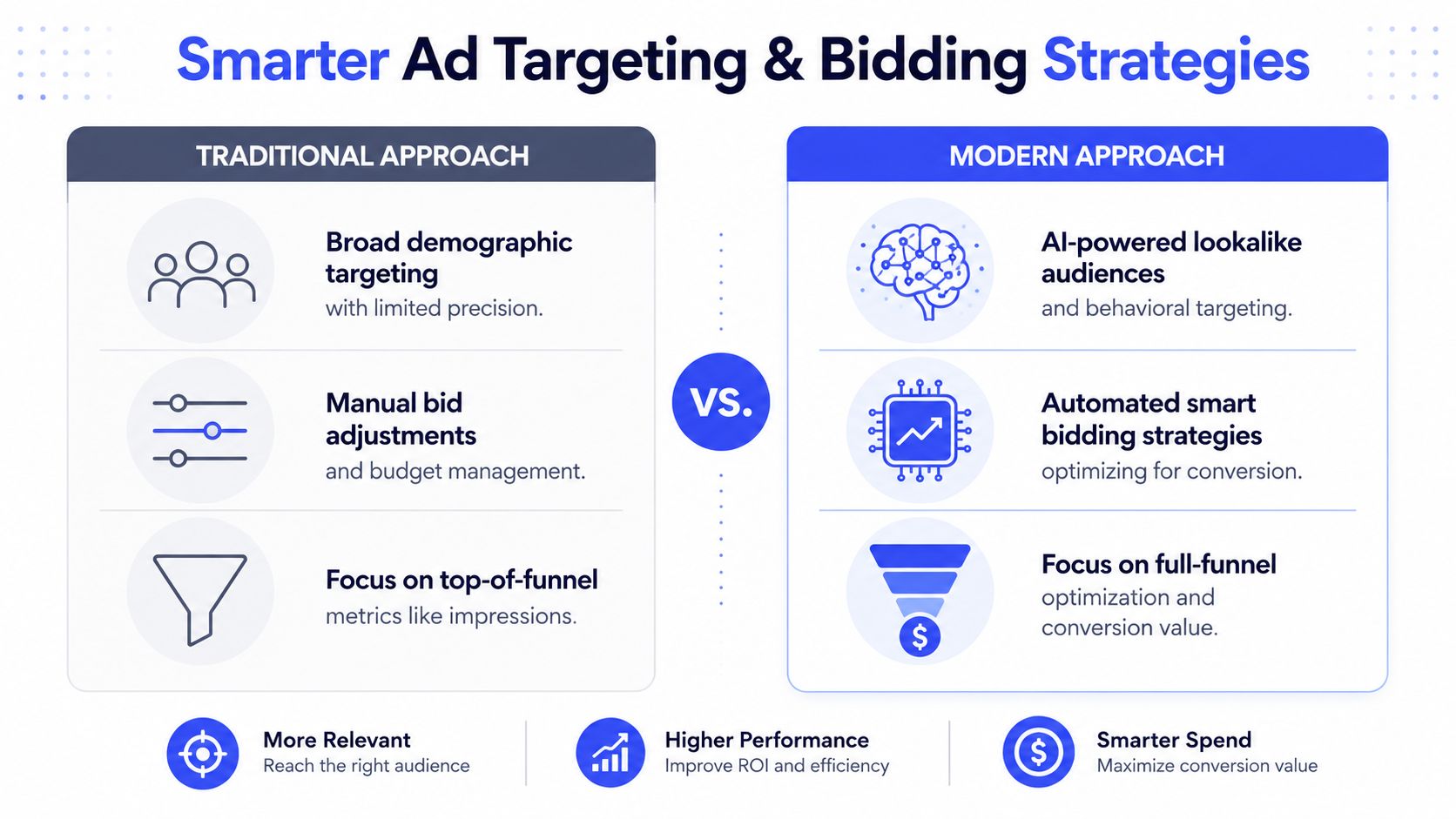
Modern account structure usually benefits from simpler audience design. That doesn't mean targeting stops mattering. It means the team should use targeting to express strategy, not to micromanage every possibility.
A practical enterprise approach is to build targeting templates around a few repeatable scenarios:
| Scenario | Better approach | What teams should watch |
|---|---|---|
| New account or weak signal | Broader targeting with clear exclusions | Whether the conversion event is strong enough to guide delivery |
| Clear customer segment | Segment by meaningful intent or offer, not tiny interests | Whether message and landing page stay specific |
| Retargeting | Use narrower audiences with tailored creative | Frequency, overlap, and offer fatigue |
| Multi-market rollout | Standardize framework, localize message where needed | Consistency in naming, exclusions, and reporting |
Collaborative ad management is essential. If each buyer uses a different audience setup for similar launches, the team can't compare learnings cleanly. Shared templates reduce setup variance and let the team isolate what changed.
Broader targeting isn't a shortcut. It's a way to let the algorithm search while the team controls the conversion event, message, exclusions, and economics.
Match bidding logic to business reality
Bidding strategy should reflect what the business needs from the campaign. Lowest-cost delivery can be useful when the team wants maximum volume and has confidence in conversion quality. Cost-controlled approaches fit situations where efficiency drift creates real downside. Value-based logic makes more sense when order values vary enough that conversion volume alone hides performance.
The mistake is treating bid strategy as a default setting rather than a strategic choice. Teams should decide based on the constraints they're operating under:
- Need cleaner cost control: use a strategy that prevents runaway acquisition costs.
- Need more scale: allow more delivery freedom if downstream quality remains stable.
- Need higher-value customers: orient optimization toward value signals, not raw count.
- Need reliable rollouts across accounts: create documented playbooks so buyers don't improvise every launch.
That decision should happen collaboratively. Finance may care about margin tolerance. Sales may care about lead quality. Media buyers care about delivery stability. If those perspectives aren't aligned before launch, the campaign spends money while the team debates success criteria after the fact.
One more operational note: don't copy bidding logic from one account to another without context. A tactic that works with mature signal density may fail in a newer account or a market with different buying behavior. Targeting and bidding should travel with a written rationale, not just a template.
Optimize the Post-Click Experience on Landing Pages
A click only matters if the page finishes the job. Too many paid social teams treat the landing page as fixed infrastructure instead of part of the conversion system.
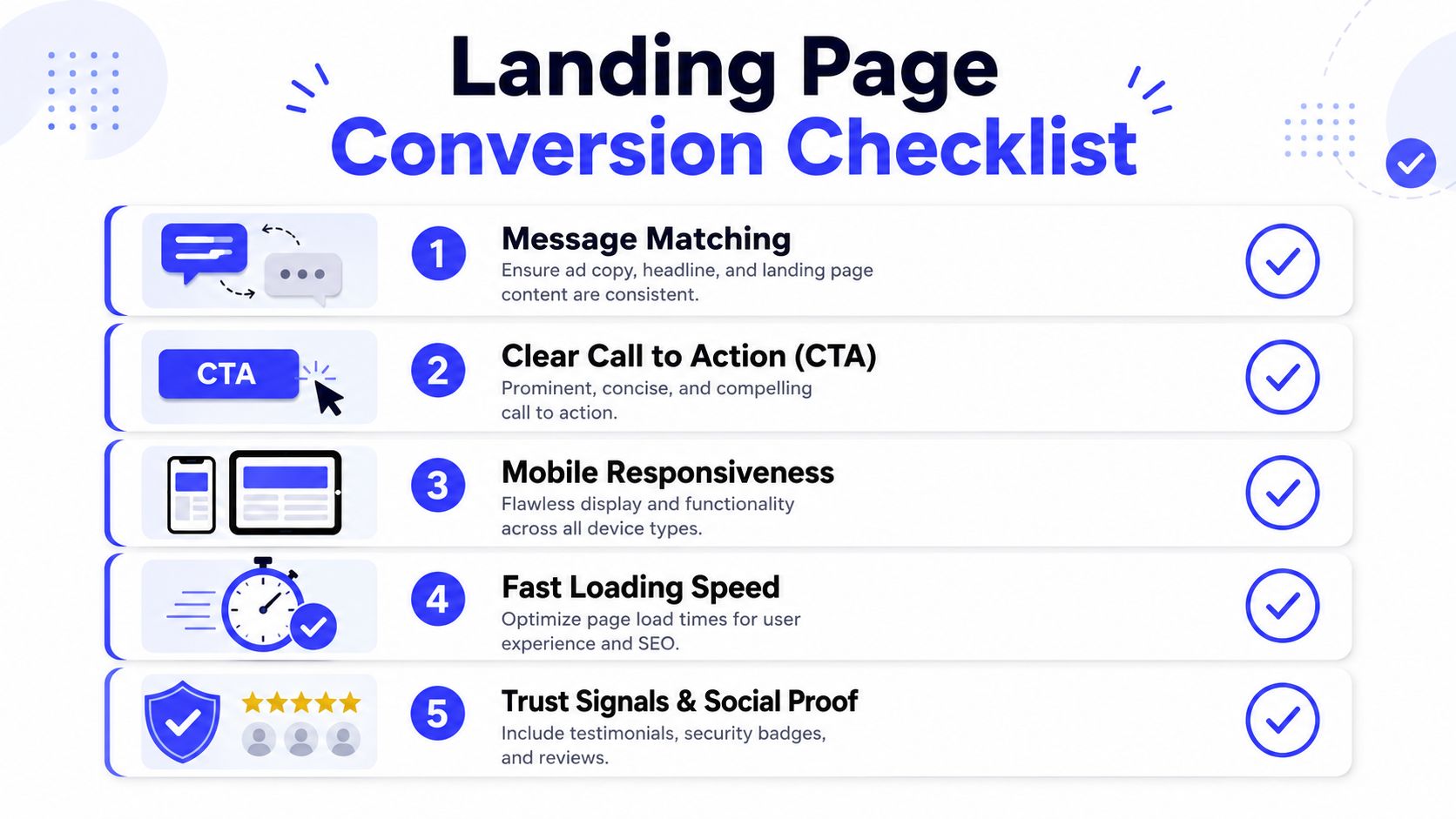
That's expensive. A 1-second delay in page load can reduce conversions by 7%, and personalized calls-to-action performed 202% better than generic CTAs in research cited by Matomo in this conversion optimization roundup. Technical speed and message relevance directly affect whether ad spend turns into revenue.
Match the promise of the ad
The first landing page job is continuity. If the ad sold simplicity, urgency, expert support, price clarity, or a specific product outcome, the page should reflect that immediately.
A tight message match usually requires alignment on five visible elements:
- Headline: repeat the core promise in language close to the ad.
- Hero visual: reinforce the same use case or audience context.
- Offer framing: keep pricing, incentives, and positioning consistent.
- CTA language: make the next step feel like the natural continuation of the click.
- Proof: support the ad's claim with the right kind of trust signal.
Media buyers should not hand off a page brief and disappear. They see CTR patterns, drop-off by ad angle, and audience-level differences. Web and CRO teams control implementation, but they need the front-end performance context to know what to change first.
Reduce friction where buyers hesitate
When a page underperforms, teams often jump to a redesign. Most of the time, smaller fixes deliver more value faster.
Use a friction review for these areas:
Form burden
Shorten forms where possible. Ask only for the fields the next step requires.Mobile usability
Check whether the important message, CTA, and proof elements appear cleanly on smaller screens.Load speed
Compress heavy assets, remove avoidable bloat, and test performance after every major page change.Trust and reassurance
Add reviews, testimonials, user-generated content, or other proof that addresses hesitation near the CTA.CTA specificity
Generic buttons often underperform because they don't tell the visitor what happens next.
A useful operating rhythm is a weekly paid social and landing page review where one team brings front-end traffic insights and the other brings on-page behavior findings. That prevents the usual split where media blames the page and web blames the traffic.
If the ad and page are managed by different teams, conversion performance improves fastest when they review the same session recordings, page behavior, and ad breakdowns together.
The core principle is simple. Don't optimize the ad in isolation. Optimize the path from impression to click to landing page to qualified outcome.
Automate and Scale Your Wins with Rules and Workflows
Manual optimization breaks first in high-volume accounts. Not because the team lacks skill, but because the decision load gets too high. Checking spend pacing, watching early signals, pausing losers, and scaling winners across many campaigns eventually turns into tab management.
Automation fixes that only when the team has already defined how decisions should be made. A rigorous conversion workflow is usually sequenced as research, hypothesis, prioritization, testing, and learning, with a minimum sample size set before launch and a confidence target of roughly 90–95% before segmenting results to avoid false winners, as outlined in this testing workflow for conversion optimization.
Automate only after the decision logic is clear
A lot of teams automate the wrong things too early. They create rules around shallow metrics because those numbers appear quickly, then the platform optimizes toward noise.
Better automation starts with explicit decision rules:
| Decision | Human input needed first | What can be automated later |
|---|---|---|
| Pause underperformers | Define failure thresholds and guardrails | Rule-based pausing once thresholds are stable |
| Scale winners | Confirm what “winner” means by campaign type | Budget increases within approved parameters |
| Launch new tests | Approve naming, assets, audience logic, and QA | Templated publishing and rollout steps |
| Report exceptions | Decide which anomalies matter | Alerts and scheduled summaries |
Workflow tools can be effective. Used carefully, a platform like Koast can centralize campaign creation, asset organization, approvals, publishing, and optimization rules across multiple Meta ad accounts. That matters less for solo buyers and much more for teams that need governance, role clarity, and repeatable execution.
Build workflows that protect budget and speed up action
Once your rules reflect business priorities, automation becomes a force multiplier.
The most useful workflows usually do three things well:
- Protect downside: pause ads or ad sets that drift outside acceptable efficiency or quality thresholds.
- Support scale: increase budgets on proven combinations without waiting for someone to log in at the right moment.
- Reduce handoff delays: keep buyers, creative teams, and leadership aligned through shared updates and activity visibility.
A strong automation layer doesn't replace judgment. It preserves it. The team still chooses the conversion event, sets the test design, reviews segment-level outcomes, and decides whether a winner should scale broadly or only in a specific context.
One practical advantage is that automation creates consistency across accounts. If an agency team or enterprise growth team manages many launches at once, rules and templates reduce the variance caused by memory, speed, or individual habits. The result is less wasted spend and faster iteration on the decisions that require human thinking.
For teams building that kind of operating system, marketing automation integration patterns for campaign execution and reporting are useful because they connect optimization logic with the rest of the team's workflow instead of treating automation as a separate layer.
If your team is trying to optimize for conversions across multiple Meta ad accounts, Koast is built for the operational side of that problem. It gives teams a single place to launch campaigns, manage creative libraries, apply templates, monitor KPIs, and automate actions like stop-loss rules and budget scaling, which helps reduce manual work while keeping governance and visibility intact.