Your team probably has some version of the same scene open right now. Google Ads in one tab. Meta Ads Manager in another. LinkedIn Campaign Manager somewhere in the background. A creative brief in Docs, pacing notes in Sheets, screenshots in Slack, and a half-finished budget update waiting for finance.
That mess usually isn't a discipline problem. It's an operating model problem.
Most growth teams don't struggle because they picked the wrong channel once. They struggle because online advertising platforms multiply decisions, duplicate work, and create governance gaps as spend, stakeholders, and account count grow. The hard part isn't only getting performance from a platform. It's choosing the right mix, launching consistently, measuring cleanly, and keeping everyone aligned without turning campaign management into a weekly fire drill.
Table of Contents
- Navigating the Digital Advertising Maze
- Search platforms
- Social platforms
- Display and video platforms
- Programmatic platforms
- Ad networks and native platforms
Navigating the Digital Advertising Maze
A lot of platform confusion starts after a team outgrows a simple channel mix. When you're only running branded search and a handful of retargeting campaigns, you can manage with disciplined spreadsheets and a strong operator. Once you add prospecting on Meta, lead gen on LinkedIn, YouTube video, programmatic awareness, and regional variations, the cracks show fast.
Creative gets versioned in too many places. Naming conventions drift. One buyer launches with the latest offer, another uses an old landing page, and analytics finds out later that the UTM structure changed mid-flight. Nobody intended to create chaos. The system produced it.
Practical rule: If campaign execution depends on one person remembering where everything lives, the process isn't scalable.
The ad platform environment also pushes teams toward siloed thinking. Search specialists focus on intent capture. Paid social teams push creative testing. Demand gen wants lead quality. Finance wants predictable spend pacing. Leadership wants a clear story. All of those are valid goals, but they often live in separate meetings and dashboards.
Strong teams treat platform management as a shared operating function, not a set of isolated channel tasks. That means agreeing on a few basics early:
- Shared objectives: Everyone needs the same definition of what success looks like for the campaign.
- Role clarity: Buyers, designers, analysts, and approvers should know who owns setup, QA, reporting, and sign-off.
- Governance standards: Naming, asset approval, budget movement, and access permissions need rules before scale exposes the gaps.
- Reusable workflows: Templates beat heroics. Repeated work should be documented or automated.
The payoff isn't only cleaner execution. It is speed with control. Teams can test more, report more clearly, and reduce the friction that usually appears when more platforms enter the mix.
Understanding the Five Core Types of Ad Platforms
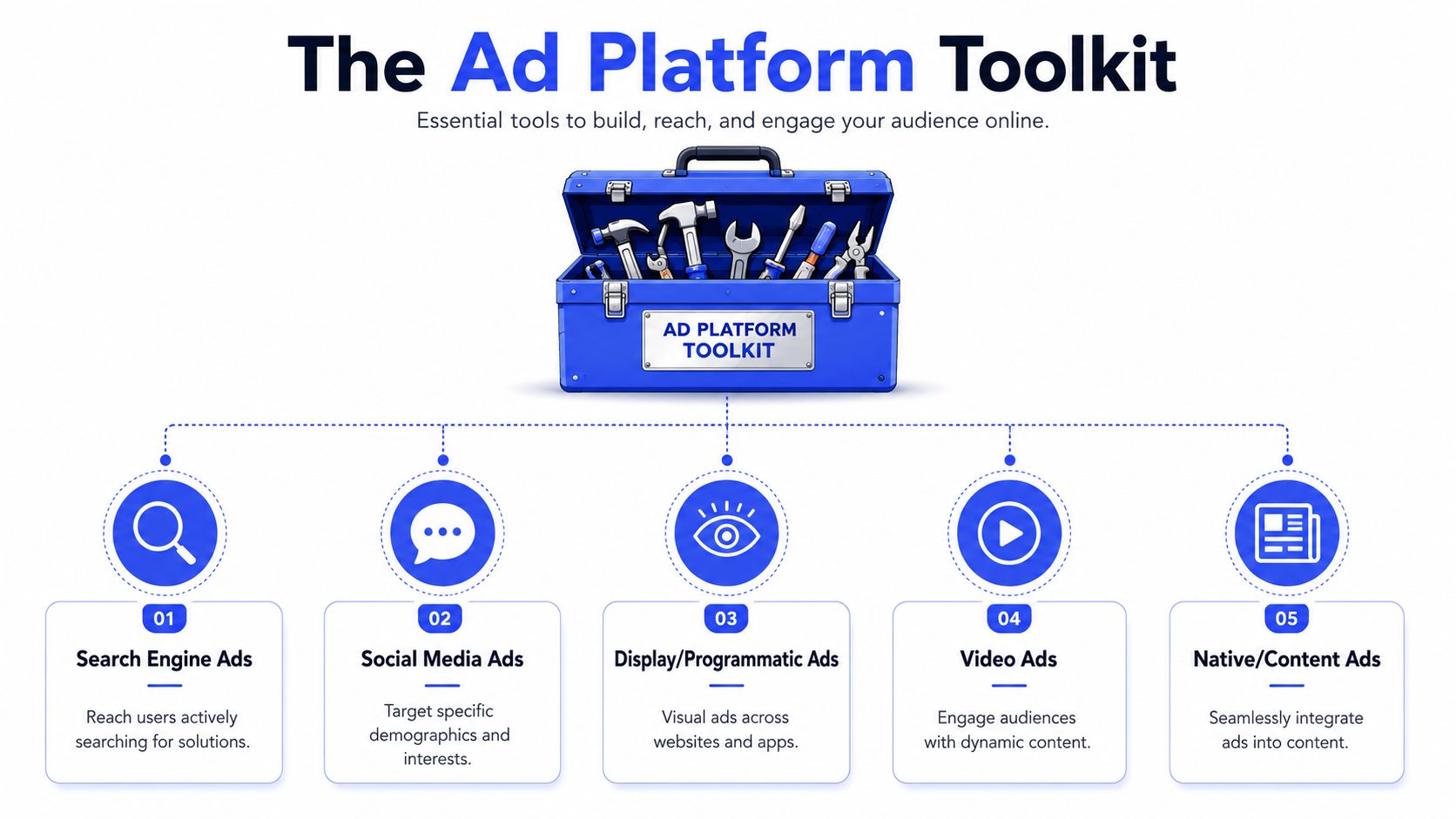
Think about online advertising platforms like a mechanic's toolkit. You wouldn't use the same tool for diagnostics, heavy lifting, precision work, and finishing detail. Ad platforms work the same way. Each one exists to solve a different marketing problem, and teams get better results when they choose the platform for the job instead of forcing every objective into the same channel.
Search platforms
Search platforms, with Google Ads as the clearest example, are built to capture existing intent. Someone has a problem, need, or category in mind and searches for it directly. That makes search especially useful when demand already exists and the team's job is to intercept it with the right keyword strategy, landing page, and offer.
Search works well when product-market fit is clear and conversion paths are direct. It works less well when buyers don't yet know what to search for. Teams often expect search to create demand from nothing. It usually won't.
Operationally, search also rewards rigor. Query management, match type discipline, negative keywords, and landing page alignment require close coordination between media buyers, content teams, and web owners.
Social platforms
Social platforms such as Meta Ads and LinkedIn are built to shape demand and target audiences before they search. These platforms are strong when you know who you want to reach and can package a compelling message in a native creative format.
Meta tends to favor broad testing, fast feedback loops, and creative volume. LinkedIn is usually a more deliberate environment where audience definition and offer relevance matter more than creative churn alone. The trade-off is that social can feel efficient while still hiding weak downstream quality if the team doesn't connect it to pipeline or revenue outcomes.
For large teams, social's biggest challenge isn't access to targeting. It's creative operations. If design, copy, compliance, and media don't work from a shared library and approval flow, launch speed drops and mistakes creep in.
Display and video platforms
Display and video platforms are useful when your goal is reach, repeated exposure, and message reinforcement across sites, apps, and streaming environments. YouTube sits in this bucket for many teams, though video can also be bought through broader demand-side tools.
These channels are strong when you need storytelling, category education, or visual reinforcement that a text ad can't provide. They're weaker when the team expects immediate bottom-funnel efficiency from broad prospecting without supporting retargeting or strong creative sequencing.
Display and video usually work better as part of a system than as a standalone answer.
Programmatic platforms
Programmatic platforms such as The Trade Desk give teams centralized buying and audience management across large inventories. They matter most when scale, cross-publisher access, advanced audience logic, and media governance matter more than simplicity.
The upside is reach and control. The downside is complexity. Programmatic introduces more stakeholders, more setup decisions, and more room for operational slippage if trafficking, reporting, and QA aren't tightly managed. Teams exploring this model should understand the workflow implications before they scale it. This programmatic optimization marketing guide is a useful operational primer.
Ad networks and native platforms
Ad networks and native platforms distribute ads across collections of publishers or placements, often with simpler buying mechanics than full programmatic setups. Native placements, in particular, can fit content-led strategies where the ad should feel close to the surrounding editorial experience.
These platforms can extend reach efficiently, but they require clear brand guardrails and careful monitoring. If the team can't answer where ads ran, what creative version was used, and how exclusions were applied, governance becomes the primary issue, not media performance.
Comparing Key Features and Pricing Models
Teams often compare platforms by performance first. That makes sense, but it misses the bigger operating question. What kind of work does each platform create for the team? A platform isn't just a media channel. It's a combination of targeting logic, creative requirements, reporting depth, and budget behavior.
What teams actually compare
The practical comparison usually comes down to four areas.
- Targeting style: Search captures explicit intent. Social leans on audience traits, behaviors, and platform signals. Display and native can rely more heavily on placements or contextual relevance. Programmatic adds more flexibility, but also more setup complexity.
- Creative burden: Search is mostly copy and landing page driven. Social needs a steady stream of approved visuals, variations, and hooks. Video requires stronger production planning. Native needs editorial alignment.
- Reporting usability: Some platforms are easy to read but limited in cross-platform context. Others provide more dimensions but demand a stronger analytics layer to make the data useful for decision-making.
- Workflow fit: A platform may perform well in isolation and still be a bad fit if it creates handoff bottlenecks, duplicate reporting, or asset sprawl.
Here's a simple planning view teams can use in channel strategy sessions.
| Ad Platform Types at a Glance | |||
|---|---|---|---|
| Platform Type | Primary Goal | Key Targeting Method | Common Pricing Model |
| Search | Capture active demand | Keyword and query intent | CPC, CPA |
| Social | Generate and convert demand | Demographic, interest, behavioral, first-party audience | CPM, CPC, CPA |
| Display and Video | Build awareness and reinforce messaging | Contextual, audience, placement | CPM, CPV, CPC |
| Programmatic | Scale audience buying across inventory | Audience data, contextual, publisher access | CPM, CPA |
| Ad Networks and Native | Extend reach in distributed environments | Publisher network, contextual, audience segments | CPC, CPM |
How pricing models change planning
Pricing model discussions shouldn't stay inside the paid media team. They affect forecast confidence, creative requirements, and how you explain performance to leadership.
CPC works well when traffic quality and click intent are the focus. It gives teams a clean way to think about traffic acquisition, but it can encourage shallow optimization if nobody looks beyond clicks.
CPM is common when reach, impressions, or audience exposure matter. This model suits awareness and creative-led channels, but teams need stronger discipline around frequency, audience overlap, and downstream measurement.
CPA sounds appealing because it aligns with outcomes. In practice, it only works well when tracking is solid and the platform has enough signal to optimize against the chosen action. Otherwise, teams can end up chasing unstable results.
Finance reality: The pricing model changes how confidently you can forecast spend pacing, acquisition efficiency, and creative production needs. Media, finance, and analytics should review those assumptions together before launch.
A common failure mode is treating pricing language as interchangeable. It isn't. If one stakeholder thinks in clicks, another in impressions, and another in qualified actions, reporting meetings turn into translation exercises. Enterprise teams avoid that by defining the decision metric, the reporting metric, and the finance metric separately before campaigns go live.
Choosing the Right Platform Mix for Your Goals
A team approves a new channel on Monday, launches by Thursday, and spends the next month chasing reporting gaps, asset bottlenecks, and unclear ownership. That is usually not a platform problem. It is a platform mix problem.
The right mix supports your business goals and your operating model at the same time. A channel can look attractive in isolation and still be the wrong choice if your team cannot feed it with creative, measure it cleanly, or govern it without adding avoidable complexity.
Match the platform to the job
Start with the buying situation, then pressure-test whether the team can run that channel well.
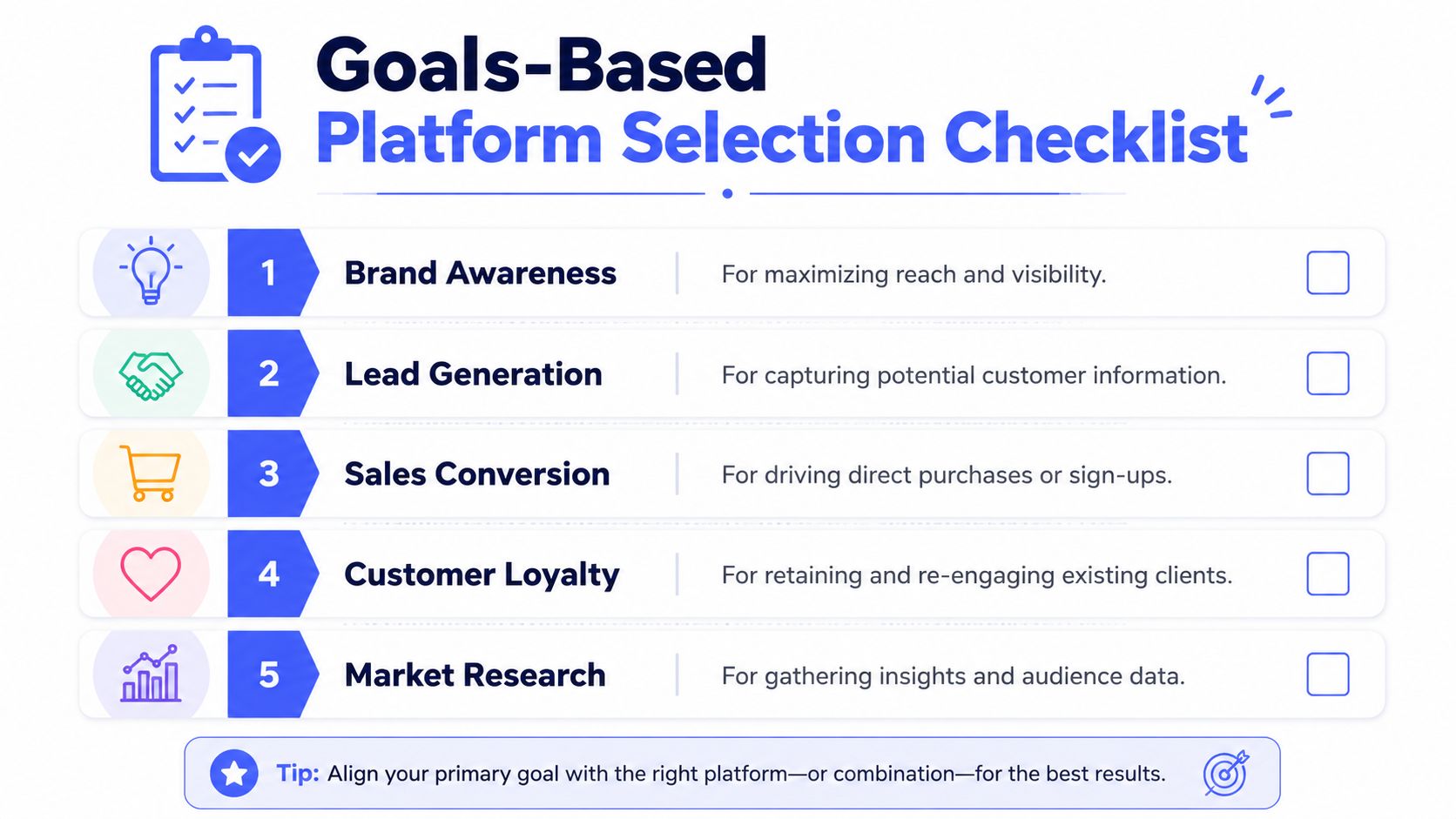
For brand awareness, broad-reach social, video, display, and selected programmatic inventory usually fit better than pure search. The job is to create familiarity before demand becomes explicit. That choice also increases creative volume, audience management work, and frequency control requirements, so media and creative teams need to plan together early.
For lead generation, platform selection depends on how much qualification you need before the sales team gets involved. LinkedIn often fits higher-consideration B2B offers where job function and company context matter. Meta can work well for broader demand capture if creative testing is active and lead follow-up is fast. Search is strongest when buyers already understand the category and want to compare options.
For direct sales, search and high-intent social placements usually do more of the heavy lifting. Retargeting across social and display can improve conversion efficiency, but only when product feeds, audience exclusions, landing page performance, and offer logic are managed tightly. If those basics are inconsistent, adding more retargeting just scales waste.
Customer loyalty deserves a place in the platform mix conversation too. Existing-customer suppression, win-back campaigns, cross-sell audiences, and retention-focused creative often produce better efficiency than chasing every new prospect. The operational question is whether CRM, lifecycle, and paid media teams share audience rules and reporting definitions, or work from separate versions of the customer record.
A useful selection review asks five questions:
- Where does intent already exist, and where do we need paid media to create it
- What level of creative production does each platform require from this team
- How quickly can sales, lifecycle, or site teams act on the traffic or leads generated
- Which platform adds reporting overhead the team can realistically support
- What governance risk comes with another account, another pixel, and another approval path
Make platform selection a team decision
Platform mix decisions break down when each specialist optimizes for their own channel. The paid social lead wants more creative testing. Search wants budget protection. Analytics wants cleaner attribution. Finance wants forecast stability. All of them have a point.
The fix is simple. Decide the mix in one room, with the people who will own the consequences.
Put the media buyer, creative lead, analytics owner, and budget approver in the same planning conversation before adding or removing a platform.
That discussion should resolve ownership, not just strategy.
- Setup standards: Assign one owner for naming conventions, tracking rules, access levels, and approval flow.
- Creative demand: Confirm whether the team can produce the formats, variants, and refresh cadence the platform needs.
- Measurement rules: Define the source of truth for success before launch. Teams comparing platform-reported conversions against business reporting without alignment waste weeks in review meetings. A clear Facebook ads reporting process helps when Meta is part of the mix.
- Test logic: Agree on what the platform is supposed to prove, how long the test runs, and what result justifies expansion or exit.
Good platform strategy often means saying no.
Some channels produce acceptable performance but consume too much operational energy for the control they provide. Others work well only because one experienced buyer is holding the system together manually. That is not scale. A strong platform mix is one your team can run repeatedly, govern cleanly, and improve without creating new coordination problems every quarter.
Implementing and Measuring Multi-Platform Campaigns
Execution is where strategy gets exposed. A multi-platform plan can look coherent in a planning deck and still break apart in launch week because URLs are inconsistent, assets are mismatched, and reporting fields don't line up.

Launch with consistency first
The first operational job is consistency. Not creativity. Not optimization. Consistency.
Use the same campaign naming structure across platforms where possible. Keep UTM rules standardized by channel, campaign, audience, and creative concept. Make sure tracking pixels and conversion events are implemented and tested before launch. The team shouldn't discover broken attribution after spend starts.
A centralized creative library matters more than is often acknowledged. If the latest approved video lives in one folder, cropped variants in another, and ad copy in someone's message thread, version control will fail. That creates wasted reviews, rework, and compliance risk.
A clean pre-launch workflow usually includes:
- Asset approval: Confirm the final creative, copy, CTA, and destination URL in one place.
- Tracking QA: Validate UTM structure, platform events, and landing page behavior.
- Audience review: Check exclusions, retargeting pools, geography, and overlap concerns.
- Owner assignment: Name who monitors pacing, who checks early performance, and who approves changes.
Measure what the team can act on
Cross-platform reporting should help teams make decisions, not just aggregate screenshots. That means choosing a reporting layer that can compare spend, traffic, conversion signals, and creative themes without forcing channel managers to rebuild the same dashboard every week.
For teams working through Meta reporting complexity, this guide to Facebook ads reporting workflows is useful because it focuses on operational clarity, not vanity metrics.
The best reporting setup answers three questions quickly. What changed, why did it change, and who needs to act on it.
That last question matters. If a metric drops and nobody knows whether media, creative, landing pages, or analytics owns the response, reporting has failed as an operating tool. Mature teams map each metric to an action path. They also document where manual work still dominates. Those repetitive tasks are usually the first candidates for automation.
Streamlining Workflows with Automation and Integration
A team can launch strong campaigns on one platform with a lot of manual effort. Add Meta, Google, TikTok, LinkedIn, retail media, and a few regional accounts, and the operating model starts to crack. The problem is rarely channel knowledge alone. It is version control, approvals, permissions, naming discipline, and the handoffs between people who all touch the same campaign.
Where manual workflows break
The failure points show up in the work around the ads. Creative files live in scattered folders. Buyers rebuild campaign structures instead of starting from approved templates. Access gets granted through one-off requests. Reporting logic changes by channel manager. Routine checks depend on memory, calendar reminders, or whoever notices an issue first.
Automation and integration fix those bottlenecks only when they are tied to a clear operating model. APIs, shared naming rules, synced asset libraries, automated alerts, and template-based builds reduce repeated setup and make account governance easier to enforce. Teams reviewing that architecture in more detail can use this guide to marketing automation integration.
The main gain is team efficiency. Media buyers spend less time on duplication. Creative can confirm what is live without chasing screenshots. Operations can control permissions and change history. Finance and leadership get a cleaner record of what launched, who changed it, and how budgets moved across accounts.
What integrated operations look like
Integrated operations are not about automating every click. They are about standardizing the work that should be repeatable, then leaving room for judgment where channel expertise matters.
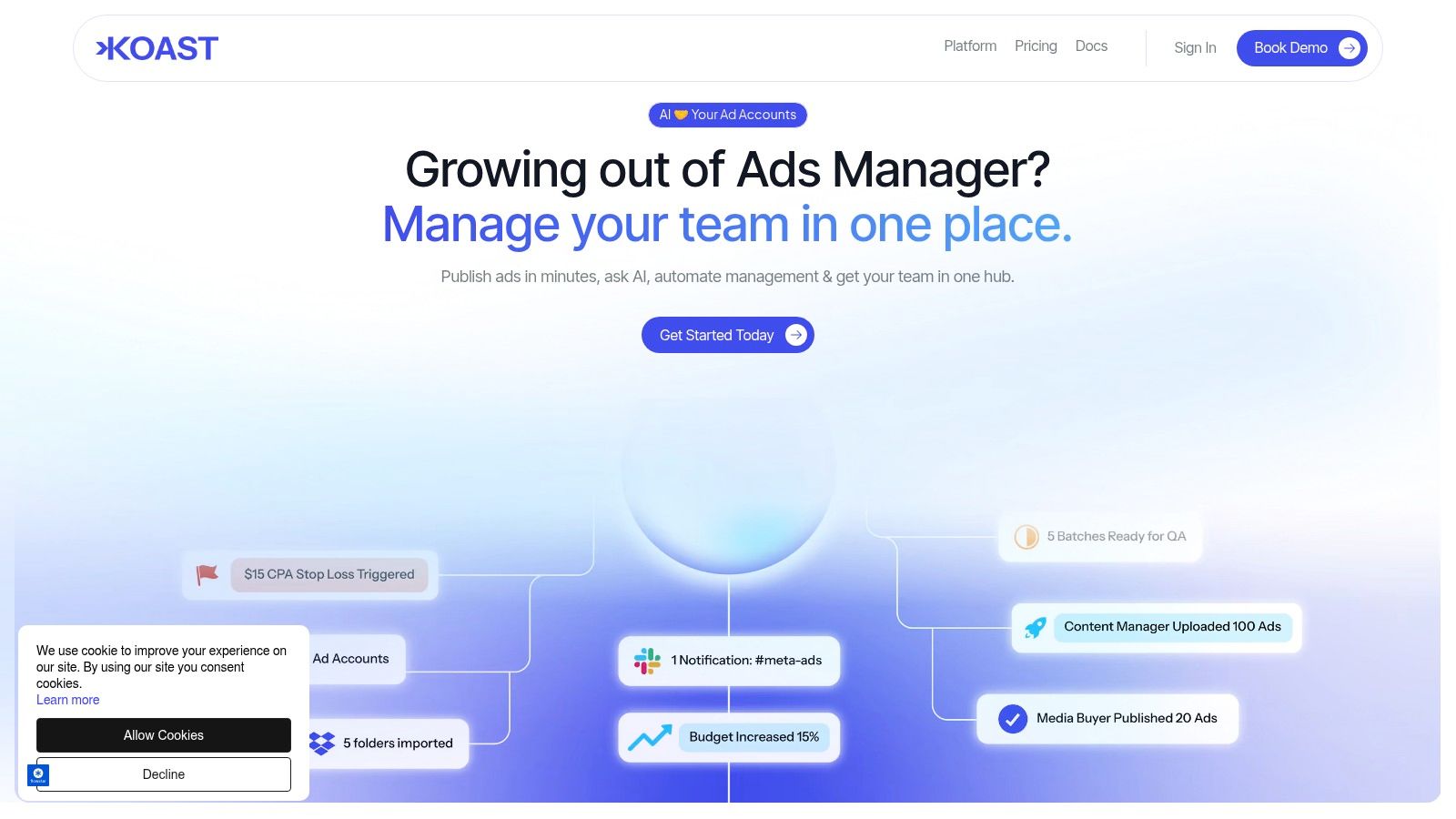
One practical example is Koast, which is built around Meta ad operations. It centralizes creative assets, supports campaign templates, applies role-based permissions, and keeps activity logs visible so teams can launch across multiple ad accounts with more control. For teams that have outgrown spreadsheet trackers and browser-tab management, that helps reduce setup time while tightening governance.
Automation also changes testing discipline. Creative uploads can follow a defined intake process. QA checks can be tied to launch criteria. Budget rules and stop conditions can be applied consistently across accounts. Channel leads still decide what to test and when to override a rule, but they do it inside a system the rest of the team can see and trust.
The same principle applies beyond paid media. Retention teams use automation to coordinate messages, offers, and timing across the customer lifecycle, which matters for driving customer loyalty and revenue.
A quick product walkthrough helps make that concrete.
The trade-off is simple. Automation speeds up good processes and scales bad ones. If naming rules are inconsistent, approvals are unclear, or teams keep changing success criteria mid-flight, software will reproduce the confusion faster. The best teams standardize first, automate second, and document ownership the whole way through.
Building a Scalable and Collaborative Ad Strategy
The teams that handle online advertising platforms well don't treat platform management as a collection of channel tricks. They treat it as an operating system. Platform choice, tracking, asset governance, reporting, permissions, and automation all sit inside the same discipline.
That matters even more when the organization grows. More stakeholders mean more approvals, more creative inputs, more budget scrutiny, and more room for drift. The answer isn't adding meetings for the sake of control. It's creating shared workflows that let buyers, creatives, analysts, and leaders work from the same source of truth.
If your team is expanding its channel mix, audit the work behind the ads, not just the ads themselves. Look for duplicated setup, unclear ownership, inconsistent naming, scattered assets, and reporting that nobody trusts enough to act on. Those are the primary constraints.
Teams that want a broader operating perspective may also find this guide to scaling agency social media helpful, especially when client delivery, collaboration, and multi-account control start to overlap with paid media operations.
Koast helps teams running Meta ads replace tab-heavy launch and optimization work with a shared workflow. If your bottleneck is campaign setup, creative coordination, or account-level governance, take a look at Koast.