Most ecommerce teams don't lose on Facebook because they lack ideas. They lose because the operating model is a mess.
Creative lives in one drive, naming conventions live in someone's head, approvals happen in Slack, and media buyers keep making account changes without a clear test log. By the time performance drops, nobody can answer basic questions fast enough: Which version launched? Who changed the audience? Was the landing page updated? Did the team scale a winner, or just spend more on a tired ad?
That chaos matters on a platform this large. Facebook is still the biggest social platform globally with 3.070 billion monthly active users, and benchmark data compiled by Sprout Social shows Facebook ads average 2.59% CTR for leads campaigns and 1.71% CTR for traffic campaigns in its marketer benchmarks roundup. For ecommerce teams, that isn't just reach. It's a reminder that Facebook advertising for ecommerce should be treated as a core acquisition system, not a side channel.
Table of Contents
- What the account should actually do
- The targeting shift most teams resist
- The naming rules that save time later
- Creative is now an operations problem
- How enterprise teams keep creative moving
- A testing cadence that teams can sustain
- Protect the first learning window
- Create rules of engagement before launch
- Document learnings like a media team, not a chat thread
- Know what you are scaling
- Use profitability guardrails, not hope
- Build automation around decisions you already trust
- Operational maturity changes the quality of every decision
- The best upgrade is usually simpler execution
Moving Beyond Ad Hoc Tactics
A familiar pattern shows up when a brand starts spending more. The founder still wants visibility into every campaign. The retention lead has opinions on offers. The design team ships assets late. The paid social manager keeps a private spreadsheet because Ads Manager alone doesn't explain what changed. Everyone is working. Few people are aligned.
That setup can limp along when volume is low. It breaks when product launches overlap, regional teams need different messages, and multiple stakeholders want fast answers. Facebook advertising for ecommerce stops being a media buying task and becomes a coordination problem.
The real bottleneck isn't ad setup
The bottleneck is usually handoff quality. Teams don't fail because they can't click "publish." They fail because the campaign brief, creative variant, audience intent, landing page, and approval state aren't connected.
When that happens, you get predictable waste:
- Duplicate tests because one buyer doesn't know another team already ran the same angle
- Creative drift because copy, offer, and visual don't reflect the same promise
- Slow reporting because performance data sits in one place and launch context sits somewhere else
- Governance gaps because nobody can clearly trace who approved what
For larger teams, process starts to matter more than hacks. A stronger operating layer often does more for performance than another round of audience tweaking. That's also why teams investing in connected systems for marketing automation integration tend to make better decisions faster. They reduce handoff friction before they try to optimize spend.
Practical rule: If your team can't reconstruct a launch decision in a few minutes, you don't have a scaling problem. You have an operating problem.
Treat the channel like infrastructure
Mature teams stop asking, "What ad should we run next?" and start asking, "What system lets us launch, learn, and scale without confusion?"
That shift changes behavior. Creative requests become structured. Approvals get explicit owners. Naming conventions stop being optional. Test results are written for future use, not just discussed in chat. The account becomes easier to audit, easier to troubleshoot, and easier to grow.
This is the baseline for modern Facebook advertising for ecommerce. Not more tabs. A cleaner operating model.
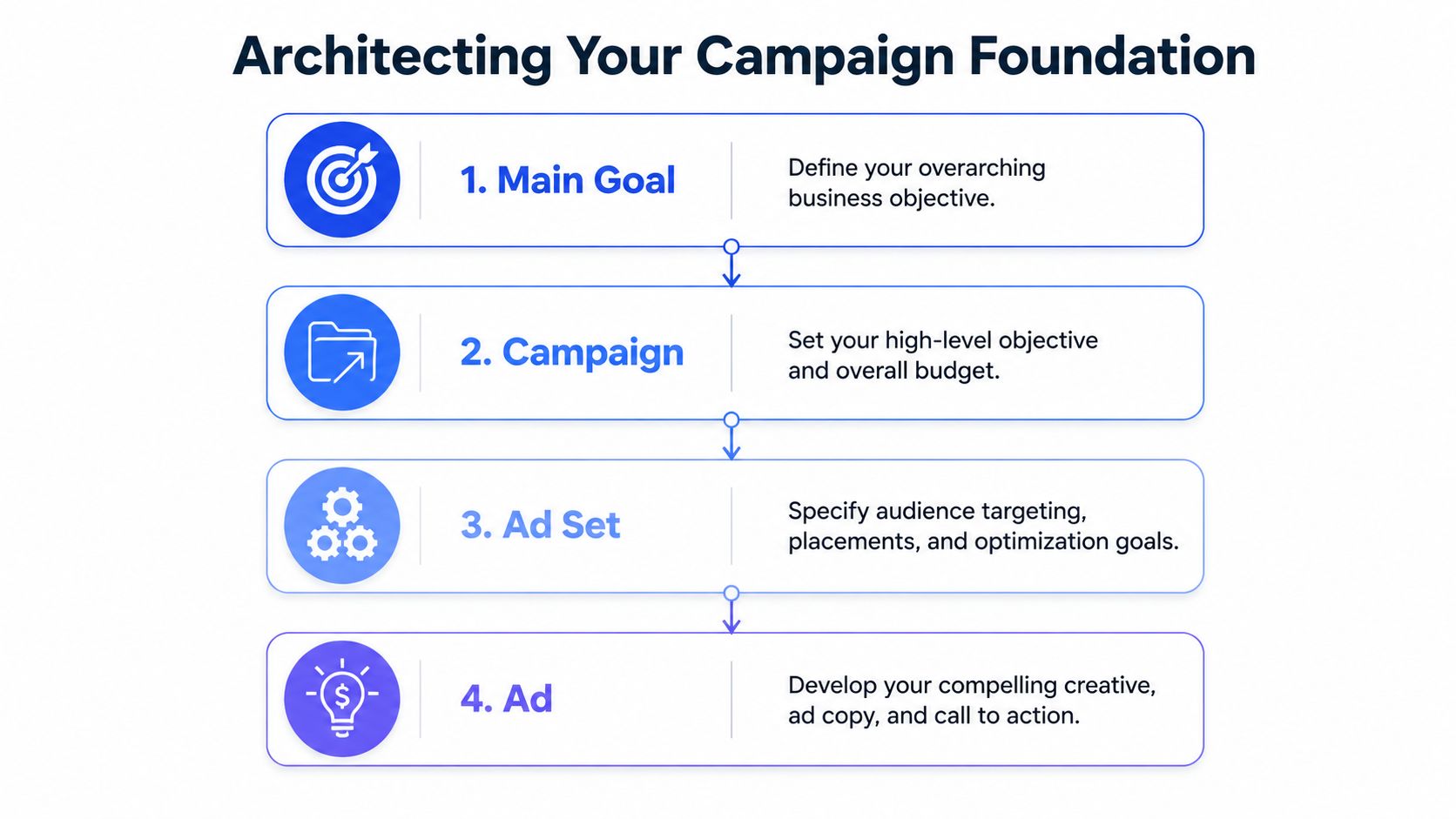
Architecting Your Campaign Foundation
The account structure should help Meta do its job and help your team understand what is happening without opening ten reports.
Most ecommerce accounts don't need a maze of micro-segmented campaigns. They need a structure that separates acquisition from recapture, preserves clarity, and gives the team a reliable place to test creative.
What the account should actually do
For most brands, the modern baseline is simple:
Broad prospecting campaign
In this campaign, you let Meta find buyers using wider audience inputs rather than overbuilt interest stacks.Catalog-based retargeting campaign
This catches product viewers, cart visitors, and other high-intent users with dynamic product relevance.Clear exclusions and clean ownership
Prospecting shouldn't cannibalize retargeting. Team ownership should be obvious so changes don't overlap.Shared definitions of success
If one team optimizes for volume and another for contribution margin, the account will drift.
LeadsBridge notes a meaningful platform shift: Meta is pushing broader targeting and phasing out many legacy interest groups, which is why merchants increasingly pair broad prospecting with catalog-based retargeting instead of relying on granular interest stacking in its ecommerce Facebook ads guidance.
The targeting shift most teams resist
The old playbook gave buyers a sense of control. Build lookalikes. Layer interests. Split ad sets until each audience looked "clean." That approach also created fragmentation, overlap, and endless debates about who deserved budget.
Broad targeting feels uncomfortable because it removes some of that manual control. But for ecommerce teams, broader structures often create cleaner learning conditions. Meta gets more room to allocate delivery. Your team gets fewer ad sets to babysit. Reporting gets simpler.
That doesn't mean "go broad" should become an excuse for lazy setup. Broad only works when the inputs are strong:
| Area | What the team must lock down |
|---|---|
| Offer | Clear reason to buy now |
| Creative | Distinct angles, not tiny edits |
| Feed quality | Accurate product titles, images, and availability |
| Landing experience | Message match from ad to page |
| Measurement | Consistent event tracking and reporting ownership |
For teams reviewing formats, placements, and campaign types, a current overview of 2026 Facebook ad options is useful because it helps planners match structure to the job each campaign is supposed to do.
The naming rules that save time later
Naming conventions sound boring until the team is trying to diagnose performance under pressure.
A workable schema usually identifies:
- Business unit or brand
- Market or region
- Funnel role
- Audience approach
- Creative angle
- Launch date or batch
Short is better than clever. If someone from finance, creative, or growth ops can't understand what a campaign is for, rename it.
Broad targeting doesn't remove the need for discipline. It raises the value of clean structure and clearer reporting.
For cross-functional teams, this is also where reporting design matters. A good internal standard for Facebook ads reporting makes it easier to connect launch context with spend, creative, and downstream performance.
Building a Collaborative Creative Workflow
Creative has become the main lever that teams can still directly control. That's why ad performance often stalls for operational reasons long before it stalls for strategic ones.
If the team can't source, review, version, approve, and relaunch creatives quickly, the account starts leaning too hard on old winners. Once that happens, buyers often try to compensate with targeting changes or budget moves that don't solve the underlying issue.
KlientBoost's roundup of Facebook ad statistics notes average conversion rates of 7.72% across industries in 2025, which reinforces a broader point for ecommerce teams: Facebook has matured into a performance system where creative that drives measurable conversion matters more than broad reach alone in its benchmark summary.
Creative is now an operations problem
Most brands say they care about creative testing. Fewer have a workflow that supports it.
What usually goes wrong:
- Files are scattered across drives, chats, and local folders
- Versions get confused because teams keep editing the same asset without a source-of-truth label
- Approvals are informal so buyers launch assets that brand or legal never fully cleared
- Test logic is weak because "new creative" is often just minor cosmetic variation
The answer isn't more meetings. It's a centralized workflow with explicit states.
A useful creative library should tell the team, at a glance:
| Asset field | Why it matters |
|---|---|
| Concept angle | Helps buyers compare message families, not just individual ads |
| Format | Distinguishes static, video, carousel, UGC-style, founder-led, and product demo assets |
| Status | Draft, in review, approved, launched, retired |
| Owner | Shows who is responsible for next action |
| Usage history | Prevents accidental relaunches and duplicate tests |
How enterprise teams keep creative moving
Large teams need role clarity. Designers shouldn't need ad account access to contribute assets. Media buyers shouldn't be guessing whether a file is approved. Brand leads should be able to review without becoming the bottleneck.
That usually means assigning workflow ownership across three lanes:
- Creative production handles hooks, scripts, concepts, and variants.
- Performance team defines test hypotheses and maps each creative to campaign use.
- Approvers manage brand, compliance, and launch readiness.
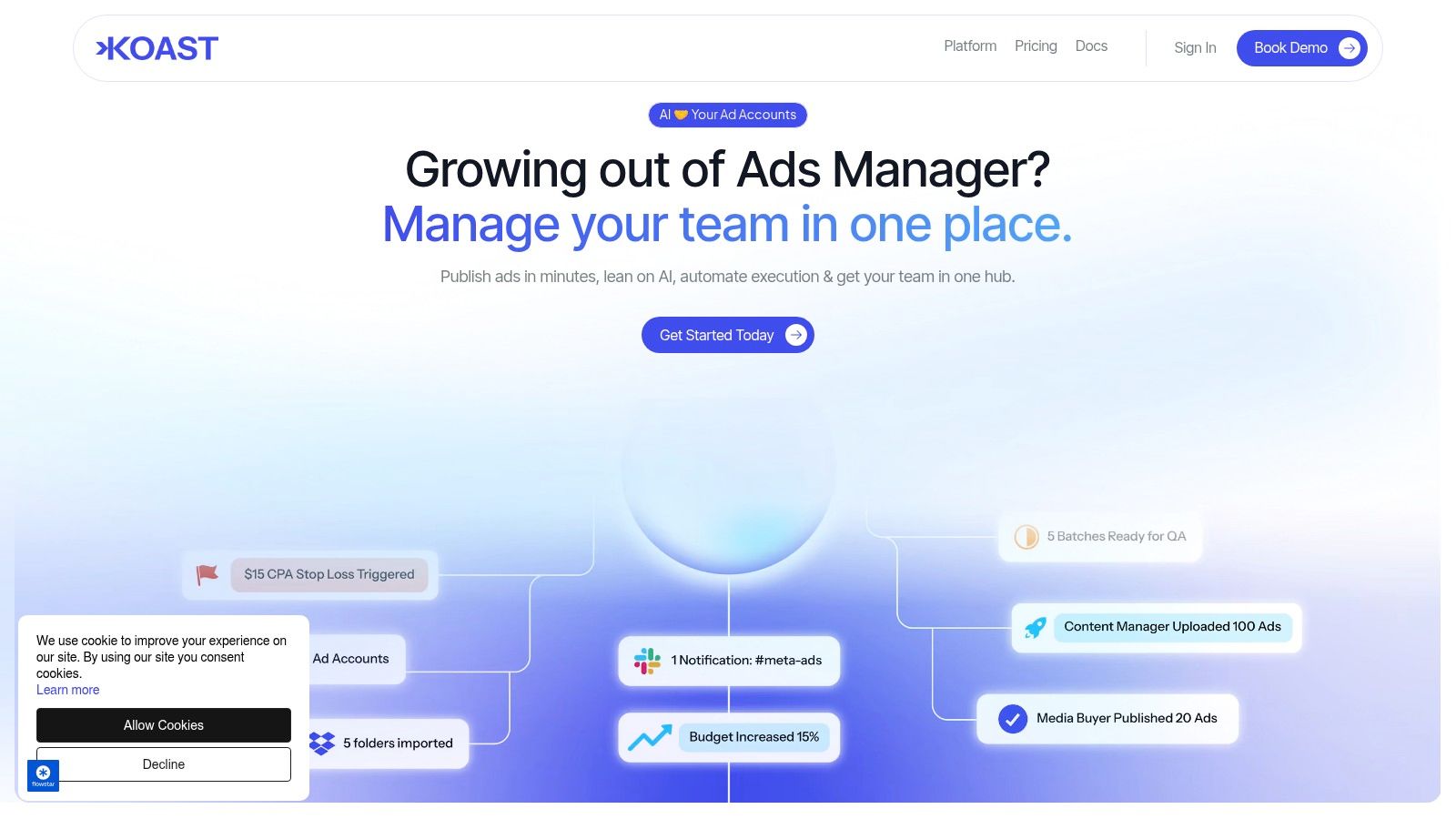
One operations layer proves valuable. Tools such as Koast centralize creative libraries, role-based permissions, and activity logs so teams can launch and monitor Meta ads with clearer governance instead of relying on screenshots and chat approvals. For teams formalizing reviews, a structured content approval workflow helps prevent rogue launches and unclear signoff.
If your team is increasing video volume, a comparative guide to the best AI video editor for ads can help creative leads choose a production workflow that fits short-form testing rather than general video editing.
The fastest media team isn't the one that launches the most ads. It's the one that knows exactly which assets are approved, live, and worth iterating.
A testing cadence that teams can sustain
Creative testing should compare meaningful differences, not microscopic edits.
Good test themes often include:
Hook variation
Lead with different buyer motivations. Problem-first, aspiration-first, proof-first, and offer-first hooks often produce very different outcomes.Format contrast
Compare polished brand creative against UGC-style or product-demo executions.Message angle
Rotate between value, quality, speed, convenience, gifting, or product education.Offer framing
The product stays the same. The purchase story changes.
A mature team keeps a backlog. Not just "ideas," but queued concepts with owner, status, and launch intent. That turns creative into a testing engine instead of a last-minute scramble.
Launching and Testing with Confidence
Most wasted spend happens in the first few days of a test, not because the idea was bad, but because the team couldn't leave it alone.
The pattern is familiar. The ad set launches. A stakeholder checks performance too early. Someone doesn't like the CTR. Another person tweaks copy, swaps creative, narrows targeting, or changes budget. The result is noisy data and no clean read on what actually happened.

Protect the first learning window
A useful operating rule is to avoid major edits until an ad set has accumulated roughly 50 conversion events within a 7-day window, which gives Meta a better chance to exit the Learning Phase with enough signal to optimize based on this ecommerce Facebook ads guide.
That rule matters because many teams sabotage tests before the platform has enough data to settle. Early interventions feel proactive. They're usually destructive.
Major edits typically include:
- Budget swings large enough to change delivery conditions
- Audience changes that alter who sees the ad
- Creative swaps that reset the core test variable
- Optimization changes that redefine what success looks like
Create rules of engagement before launch
Testing discipline doesn't come from good intentions. It comes from pre-agreed operating rules.
A clean launch checklist often answers five questions:
| Question | Team agreement |
|---|---|
| Who can edit live ads | Limit permissions to named owners |
| When reviews happen | Set specific review windows instead of constant monitoring |
| What counts as a major edit | Define it before anyone debates it mid-test |
| How results are logged | Use one shared template |
| When a test is killed or kept | Base decisions on the same criteria across the team |
This is especially important for enterprise ecommerce teams. Multiple people often touch the same campaign. Without a ruleset, "collaboration" becomes random interference.
If three people can change a live ad set without logging the reason, you're not testing. You're improvising with budget.
The review rhythm should also match the account's capacity to absorb change. Daily observation is fine. Constant intervention isn't. Teams that separate monitoring from editing usually get cleaner reads.
A practical walkthrough of launch review discipline can help align newer team members before they get ad account access:
Document learnings like a media team, not a chat thread
The test log is one of the highest-value assets in the account. Still, it is commonly treated as an afterthought.
A useful log captures:
- Hypothesis so the team remembers what the ad was trying to prove
- Creative identifiers so nobody confuses versions later
- Launch conditions including page, offer, and audience context
- Decision outcome such as iterate, relaunch, retire, or scale
- Reasoning written in plain language for the next buyer
That archive compounds. Over time, the team stops retesting old losers, gets sharper on which angles deserve expansion, and can onboard new buyers faster.
Scaling Winners and Managing Performance
Scaling is where disciplined teams separate themselves from enthusiastic ones.
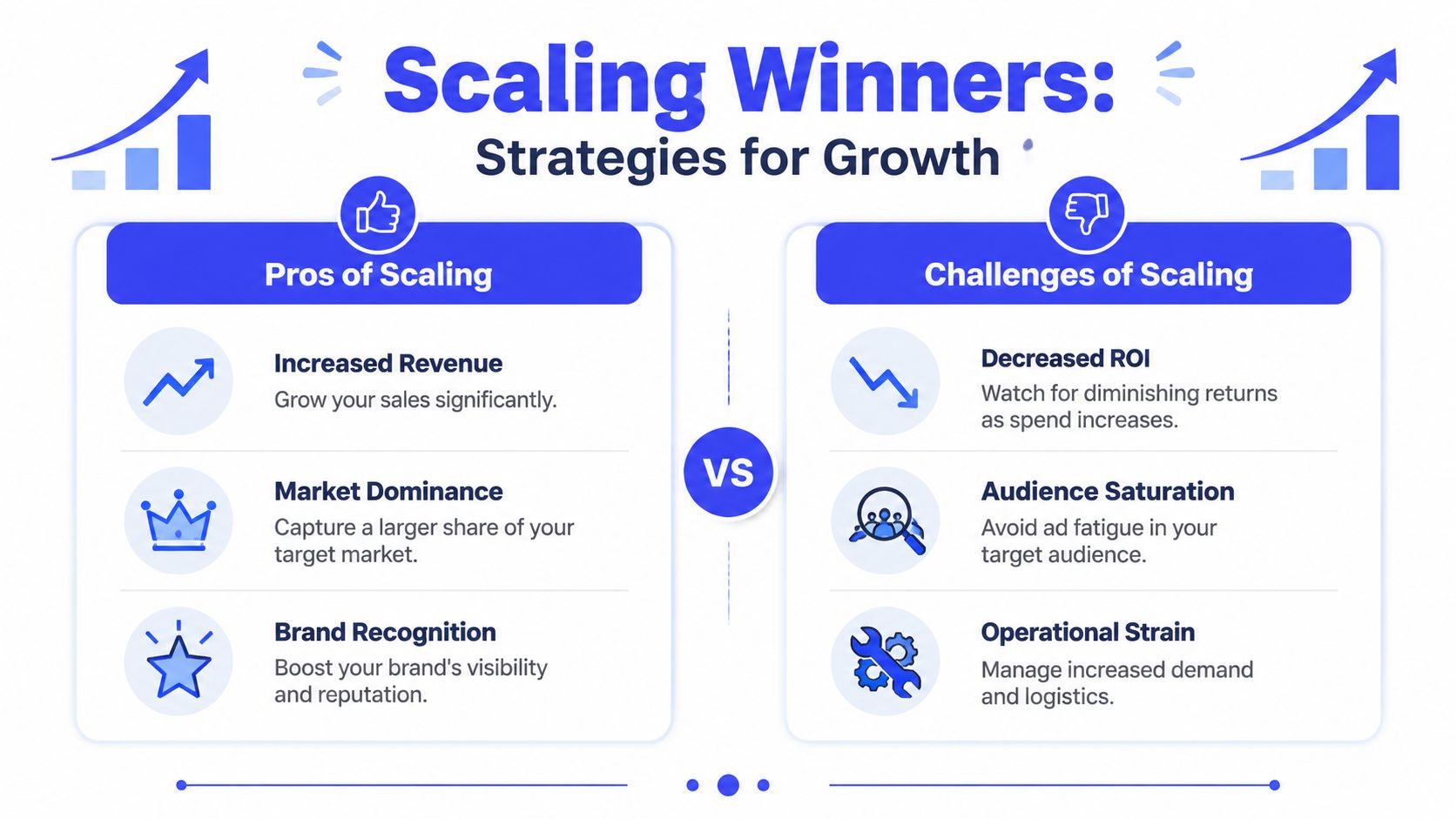
A winner isn't "the ad that spent the most." A winner is the combination of creative, audience condition, and economics that stays healthy as you ask it to do more. That distinction matters because many teams scale a temporary spike and call the later collapse "fatigue" when the issue was weak selection.
Know what you are scaling
Two scaling paths still matter in practice:
Vertical scaling
Increase budget on the winning ad set or campaign. This keeps more continuity but can create volatility if the increase is too aggressive for the account's current delivery pattern.Horizontal scaling
Duplicate proven concepts into adjacent setups. That might mean a new market, a fresh creative family built from the same message, or a separate campaign structure that preserves the original while opening new spend paths.
Neither approach is universally correct. The question is whether you're trying to get more out of a proven delivery pattern or expand beyond it without disturbing the original signal.
Use profitability guardrails, not hope
WordStream reports an average Facebook ads conversion rate of 9.21%, but ecommerce operators usually make scaling decisions around ROAS, with 4:1 ROAS often treated as a profitability target and 2:1 ROAS as a break-even floor in its Facebook advertising benchmarks.
Those benchmarks are only useful if the team applies them to real unit economics. A campaign can look acceptable in platform reporting and still lose money after product cost, shipping, returns, discounts, and payment fees.
For team decision-making, keep the guardrails visible:
Scale when margin supports it
Don't scale because a chart looks exciting. Scale when the economics still hold after fulfillment realities.Watch for audience saturation
If spend rises but efficiency degrades, the team needs fresh creative or a broader acquisition path, not blind budget increases.Separate hero ads from scalable systems
One standout ad can carry a week. It can't carry a quarter without support from adjacent concepts.
Build automation around decisions you already trust
Automation works best when it enforces a strategy the team already agrees on.
Good candidates for automated guardrails include:
| Automation type | Team use case |
|---|---|
| Stop-loss logic | Pause waste before a buyer catches it manually |
| Budget scaling rules | Increase spend on stable winners without waiting for daily check-ins |
| Alerts and reporting triggers | Notify stakeholders when performance moves outside expected bounds |
| Creative rotation prompts | Flag ads that may need a refresh before the account leans too hard on them |
The mistake is automating unresolved judgment calls. If your team can't agree on what qualifies as a winner, automation won't fix that. It will only move the confusion faster.
Strong scaling comes from controlled expansion. Protect the original signal, add budget carefully, and give the next wave of creative time to earn its place.
From Manual Tactics to Automated Operations
The brands that keep winning on Facebook usually aren't running a secret targeting trick. They build cleaner systems.
They structure accounts so prospecting and retargeting have distinct jobs. They treat creative as a managed workflow, not a request queue. They protect the learning window. They scale with margin guardrails. Above all, they make it easy for multiple teams to work in the same environment without stepping on each other.
That matters more now because Facebook advertising for ecommerce has become a coordination challenge across growth, design, analytics, merchandising, and finance. A good ad account can still underperform if the surrounding workflow is chaotic.
Operational maturity changes the quality of every decision
When teams centralize assets, document launch logic, and standardize reporting, several things happen:
- Fewer launch errors because approvals and ownership are visible
- Faster iteration because buyers can pull from organized creative inputs
- Cleaner reporting because naming and test logs match the account structure
- Better executive communication because spend decisions connect to operating context
This is also where broader technology choices start to matter. If your team is evaluating powerful AI solutions for e-commerce, the useful question isn't which tool sounds advanced. It's which systems reduce handoff friction, preserve governance, and let the team act on performance signals without creating more operational noise.
The best upgrade is usually simpler execution
Enterprise teams don't need more dashboards disconnected from action. They need fewer manual steps between idea, approval, launch, and optimization.
That often means consolidating:
- Creative intake and storage
- Approval workflows
- Launch templates
- Performance monitoring
- Optimization rules
Once that operating layer is in place, the account becomes more stable. Buyers spend less time on repetitive tasks. Creative teams get clearer feedback. Leaders get a more reliable view of what's driving growth and what's just creating motion.
The point isn't to remove human judgment. It's to reserve human judgment for the decisions that deserve it.
If your team is managing Facebook advertising for ecommerce across multiple products, markets, or ad accounts, Koast is worth evaluating as an operating layer for launch and optimization. It gives teams one place to manage creative assets, permissions, QA, publishing, and automation so ad execution doesn't depend on spreadsheets, scattered approvals, and constant manual account work.